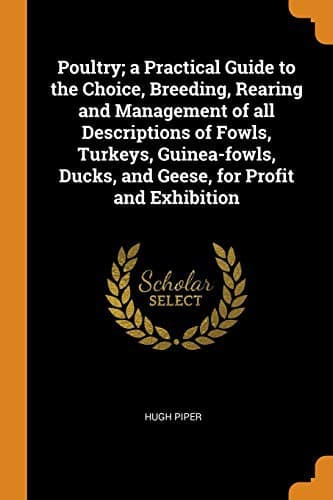
Poultry: A Practical Guide to the Choice, Breeding, Rearing, and Management of all Descriptions of Fowls, Turkeys, Guinea-fowls, Ducks, and Geese, for Profit and Exhibition.Piper, Hugh
Science
Poultry: A Practical Guide to the Choice, Breeding, Rearing, and Management of all Descriptions of Fowls, Turkeys, Guinea-fowls, Ducks, and Geese, for Profit and Exhibition.
Piper, Hugh
Poultry -- Breeding
The coop should be like that used for common fowls, but two feet broad,
and higher, being about three feet high in front and one foot at the
back; this greater slant of the roof being made in order to confine her
movements, as otherwise she would move about too much, and trample upon
her brood. When they have grown larger they must have a larger coop,
made of open bars wide enough apart for them to go in and out, but too
close to let in fowls to eat their delicate food, and the hen must be
placed under it with them. A large empty crate, such as is used to
contain crockery-ware, will make a good coop for large poults; but if
one cannot be had, a coop may be made of laths or rails, with the bars
four inches apart; it should be about five feet long, four feet broad,
and three feet high.
Keep her cooped for two months, moving the coop every fine, dry day into
a grass field, but on cold or wet days keep them in the outhouse. If she
is allowed her liberty before they are well grown and strong, she will
wander away with them through the long grass, hedges, and ditches, over
highway, common, and meadow, mile after mile, losing them on the road,
and straying on with the greatest complacency, and perfectly satisfied
so long as she has one or two following her, and never once turning her
head to see how her panting chicks are getting on, nor troubled when
they squat down tired out, and implore her plaintively to come back; and
all this arises from sheer heedlessness, and not from want of affection,
for she will fight for her brood as valiantly as any pheasant will for
hers. When full grown they should never be allowed to roam with her
while there is heavy dew or white frost on the grass, but be kept in
till the fields and hedgerows are dry. They will pick up many seeds and
insects while wandering about in the fields with her, but must be fed by
hand three or four times a day at regular intervals.
They cease to be chicks or chickens, and are called turkey-poults when
the male and female distinctive characteristics are fairly established,
the carunculated skin and comb of the cock being developed, which is
called "shooting the red," or "putting out the red," and begins when
they are eight or ten weeks old. It is the most critical period of their
lives--much more so than moulting, and during the process their food
must be increased in quantity, and made more nourishing by the addition
of boiled egg-yolks, bread crumbled in ale, wheaten flour, bruised
hempseed, and the like, and they must be well housed at night. When this
process is completed they will be hardy, and able to take care of
themselves; but till they are fully fledged it will be advisable to keep
them from rain and cold, and not to try their hardness too suddenly.
Public-domain text, read in full here on John Shaqi.
Reviews
Reviews
No reviews yet
Be the first to share your thoughts on this work.
Elsewhere in the archive
Join the Discussion
Join the discussion
Sign in to leave a comment or review.
Sign InorCreate an account