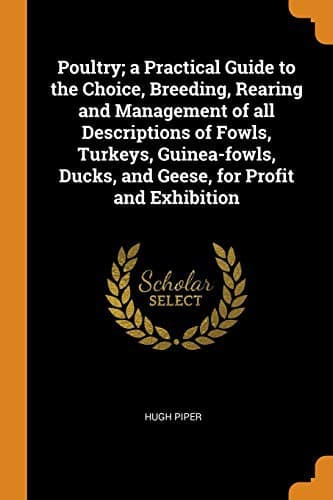
Poultry: A Practical Guide to the Choice, Breeding, Rearing, and Management of all Descriptions of Fowls, Turkeys, Guinea-fowls, Ducks, and Geese, for Profit and Exhibition.Piper, Hugh
Science
Poultry: A Practical Guide to the Choice, Breeding, Rearing, and Management of all Descriptions of Fowls, Turkeys, Guinea-fowls, Ducks, and Geese, for Profit and Exhibition.
Piper, Hugh
Poultry -- Breeding
evening." All the hemlock or deadly nightshade within range should be
destroyed. When the corn is garnered the young geese may be turned into
the stubble which they will thoroughly glean, and many of them will be
in fine condition by Michaelmas. Green geese are young geese fattened at
about the age of four months, usually on oatmeal and peas, mixed with
skim-milk or butter-milk, or upon oats or other grain, and are very
delicate. In fattening geese for Christmas give oats mixed with water
for the first fortnight, and afterwards barley-meal made into a
crumbling porridge. They should be allowed to bathe for a few hours
before being killed, for they are then plucked more easily and the
feathers are in better condition. Their feathers, down, and quills are
very valuable.
Geese are very destructive to all garden and farm crops, as well as
young trees, and must therefore be carefully kept out of orchards and
plantations. Their dung, though acrid and apt to injure at first, will,
when it is mellowed, much enrich the ground.
The Toulouse or Grey Goose is very large, of uniform grey plumage, with
long neck, having a kind of dewlap under the throat; the abdominal pouch
very much developed, almost touching the ground; short legs; flat feet;
short, broad tail; and very upright carriage, almost like a penguin. The
Toulouse lays a large number of eggs, sometimes as many as thirty, and
even more, but rarely wishes to sit, and is a very bad mother.
The Emden or pure White is very scarce. The bill is flesh-colour, and
the legs and feet orange. They require a pond. The Toulouse, crossed
with the large white or dark-coloured common breed, produces greater
weight than either, and the objection to the former as indifferent
sitters and mothers is avoided; but is not desirable for breeding stock,
and must have a pond like the White.
CHAPTER XXIV.
DISEASES.
It is more economical to kill at once rather than attempt to cure common
fowls showing symptoms of any troublesome disease, and so save trouble,
loss of their carcases, and the risk of infection. But if the fowls are
favourites, or valuable, it may be desirable to use every means of cure.
Public-domain text, read in full here on John Shaqi.
Reviews
Reviews
No reviews yet
Be the first to share your thoughts on this work.
Elsewhere in the archive
Join the Discussion
Join the discussion
Sign in to leave a comment or review.
Sign InorCreate an account