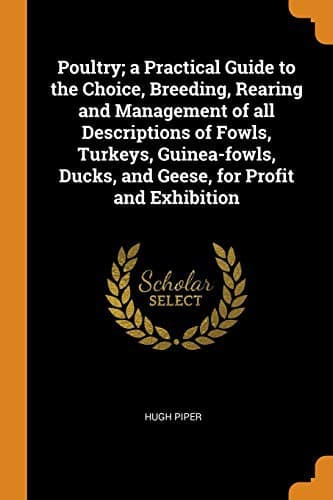
Poultry: A Practical Guide to the Choice, Breeding, Rearing, and Management of all Descriptions of Fowls, Turkeys, Guinea-fowls, Ducks, and Geese, for Profit and Exhibition.Piper, Hugh
Science
Poultry: A Practical Guide to the Choice, Breeding, Rearing, and Management of all Descriptions of Fowls, Turkeys, Guinea-fowls, Ducks, and Geese, for Profit and Exhibition.
Piper, Hugh
Poultry -- Breeding
When a paddock is used as a run for a large number of poultry, it should
be enclosed either by a wall or paling, but not by a hedge, as the fowls
can get through it, and will also lay their eggs under the hedge. The
paddock should be well drained, and it will be a great advantage if it
contains a pond, or has a stream of water running through or by it.
Mowbray advises that the grass run should be sown "with common trefoil
or wild clover, with a mixture of burnet, spurry, or storgrass," which
last two kinds "are particularly salubrious to poultry." If the grass is
well rooted before the fowls are allowed to run on it, they may range
there for several hours daily, according to its extent and their number,
but it should be renewed in the spring by sowing where it has become
bare or thin. A dry common, or pasture fields, in which they may freely
wander and pick up grubs, insects, ants' eggs, worms, and leaves of
plants, is a great advantage, and they may be accustomed to return from
it at a call. Where there is a cropped field, orchard, or garden, in
which fowls may roam at certain seasons, when the crops are safe from
injury, each brood should be allowed to wander in it separately for a
few hours daily, or on different days, as may be most convenient. "A
garden dung-heap," says Mr. Baily, "overgrown with artichokes, mallows,
&c., is an excellent covert for chickens, especially in hot weather.
They find shelter and meet with many insects there." When horse-dung is
procured for the garden, or supplied from your stables, some should be
placed in a small trench, and frequently renewed, in which the fowls
will amuse themselves, particularly in winter, by scraping for corn and
worms. When fowls have not the advantage of a grass run they should be
indulged with a square or two of fresh turf, as often as it can be
obtained, on which they will feed and amuse themselves. It should be
heavy enough to enable them to tear off the grass, without being obliged
to drag the turf about with them.
CHAPTER IV.
FOOD.
The following table, which first appeared in the "Poultry Diary," will
show at a glance the relative constituents and qualities of the
different kinds of food, and may be consulted with great advantage by
the poultry-keeper, as it will enable him to proportion mixed food
correctly, and to change it according to the production of growth,
flesh, or fat that may be desired, and according to the temperature of
the season. These proportions, of course, are not absolutely invariable,
for the relative proportions of the constituents of the grain will vary
with the soil, manure used, and the growing and ripening characteristics
of the season.
Public-domain text, read in full here on John Shaqi.
Reviews
Reviews
No reviews yet
Be the first to share your thoughts on this work.
Join the Discussion
Join the discussion
Sign in to leave a comment or review.
Sign InorCreate an account