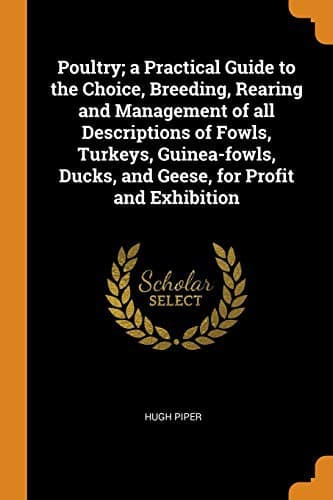
Poultry: A Practical Guide to the Choice, Breeding, Rearing, and Management of all Descriptions of Fowls, Turkeys, Guinea-fowls, Ducks, and Geese, for Profit and Exhibition.Piper, Hugh
Science
Poultry: A Practical Guide to the Choice, Breeding, Rearing, and Management of all Descriptions of Fowls, Turkeys, Guinea-fowls, Ducks, and Geese, for Profit and Exhibition.
Piper, Hugh
Poultry -- Breeding
Some persons give but one meal a day, and that generally in the morning;
this is false economy, for the whole of the nutriment contained in the
one meal is absorbed in keeping up the animal heat, and there is no
material for producing eggs. "The number of meals per day," says Mr.
Wright, "best consistent with real economy will vary from two to three,
according to the size of the run. If it be of moderate extent, so that
they can in any degree forage for themselves, two are quite sufficient,
at least in summer, and should be given early in the morning and the
last thing before the birds go to roost. In any case, these will be the
principal meals; but when the fowls are kept in confinement they will
require, in addition, a scanty feed at mid-day. The first feeding should
consist of soft food of some kind. The birds have passed a whole night
since they were last fed; and it is important, especially in cold
weather, that a fresh supply should as soon as possible be got into the
system, and not merely into the crop. But if grain be given, it has to
be ground in the poor bird's gizzard before it can be digested, and on a
cold winter's morning the delay is anything but beneficial. But, for the
very same reason, at the evening meal grain forms the best food which
can be supplied; it is digested slowly, and during the long cold nights
affords support and warmth to the fowls."
They should be fed at regular hours, and will then soon become
accustomed to them, and not loiter about the house or kitchen door all
day long, expecting food, which they will do if fed irregularly or too
often, and neglect to forage about for themselves, and thus cost more
for food.
Grass is of the greatest value for all kinds of poultry, and where they
have no paddock, or grass-plot, fresh vegetables must be given them
daily, as green food is essential to the health of all poultry, even of
the very youngest chickens. Cabbage and lettuce leaves, spinach, endive,
turnip-tops, turnips cut into small pieces and scattered like grain, or
cut in two, radish-leaves, or any refuse, but not stale vegetables will
do; but the best thing is a large sod of fresh-cut turf. They are
partial to all the mild succulent weeds, such as chickweed and
_Chenopodium_, or fat-hen, and eat the leaves of most trees and shrubs,
even those of evergreens; but they reject the leaves of strawberries,
celery, parsnips, carrots, potatoes, onions, and leeks. The supply of
green food may be unlimited, but poultry should never be entirely fed on
raw greens. Cabbage and spinach are still more relaxing when boiled than
raw. They are very fond of the fruit of the mulberry and cherry trees,
and will enjoy any that falls, and prevent it from being wasted.
Public-domain text, read in full here on John Shaqi.
Reviews
Reviews
No reviews yet
Be the first to share your thoughts on this work.
Join the Discussion
Join the discussion
Sign in to leave a comment or review.
Sign InorCreate an account