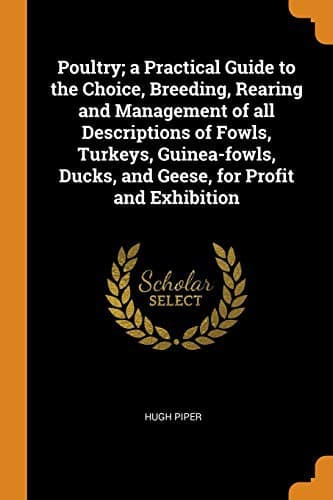
Poultry: A Practical Guide to the Choice, Breeding, Rearing, and Management of all Descriptions of Fowls, Turkeys, Guinea-fowls, Ducks, and Geese, for Profit and Exhibition.Piper, Hugh
Science
Poultry: A Practical Guide to the Choice, Breeding, Rearing, and Management of all Descriptions of Fowls, Turkeys, Guinea-fowls, Ducks, and Geese, for Profit and Exhibition.
Piper, Hugh
Poultry -- Breeding
Until of late years the breeding of poultry has been almost generally
neglected in Great Britain. Any kind of mongrel fowl would do for a
farmer's stock, although he fully appreciated the importance of breeding
in respect of his cattle and pigs, and the value of improved seeds. Had
he thought at all upon the subject, it must have occurred to him that
poultry might be improved by breeding from select specimens as much as
any other kind of live stock. The French produce a very much greater
number of fowls and far finer ones for market than we do. In France,
Bonington Mowbray observes, "poultry forms an important part of the live
stock of the farmer, and the poultry-yards supply more animal food to
the great mass of the community than the butchers' shops"; while in
Egypt, and some other countries of the East, from time immemorial, vast
numbers of chickens have been hatched in ovens by artificial heat to
supply the demand for poultry; but in Great Britain poultry-keeping has
been generally neglected, eggs are dear, and all kinds of poultry so
great a luxury that the lower classes and a large number of the middle
seldom, if ever, taste it, except perhaps once a year in the form of a
Christmas goose, while hundreds of thousands cannot afford even this. It
is computed that a million of eggs are eaten daily in London and its
suburbs alone; yet this vast number only gives one egg to every three
mouths. "It is a national waste," says Mr. Edwards, "importing eggs by
the hundreds of millions, and poultry by tens of thousands, when we are
feeding our cattle upon corn, and grudging it to our poultry; although
the return made from the former, it is generally admitted, is not five
per cent. beyond the value of the corn consumed, whereas an immense
percentage can be realised by feeding poultry." A writer in the _Times_,
of February 1, 1853, states that, while it will take five years to
fatten an ox to the weight of sixty stone, which will produce a profit
of L30, the same sum may be realised in five months by feeding an equal
weight of poultry for the table.
Although fowls are so commonly kept, the proportion to the population is
still very small, and the number of those who rear and manage them
profitably still smaller, chiefly because most people keep them without
system or order, and have not given the slightest attention to the
subject. Nevertheless, it costs no more trouble and much less expense to
keep fowls successfully and profitably, for neglected fowls are always
falling sick, or getting into mischief and causing annoyance, and often
expense and loss. "A man," says Mr. Edwards, "who expects a good return
of flesh and eggs from fowls insufficiently fed and cared for, is like a
miller expecting to get meal from a neglected mill, to which he does not
supply grain."
Public-domain text, read in full here on John Shaqi.
Reviews
Reviews
No reviews yet
Be the first to share your thoughts on this work.
Join the Discussion
Join the discussion
Sign in to leave a comment or review.
Sign InorCreate an account