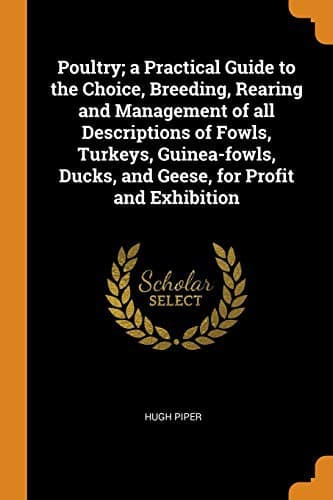
Poultry: A Practical Guide to the Choice, Breeding, Rearing, and Management of all Descriptions of Fowls, Turkeys, Guinea-fowls, Ducks, and Geese, for Profit and Exhibition.Piper, Hugh
Science
Poultry: A Practical Guide to the Choice, Breeding, Rearing, and Management of all Descriptions of Fowls, Turkeys, Guinea-fowls, Ducks, and Geese, for Profit and Exhibition.
Piper, Hugh
Poultry -- Breeding
The canary-bird would never be able to break the
shell it is enclosed in if that were as thick as the egg of a barn-door
fowl. The chick of a barn-door fowl, again, would in vain try to break
its shell if it were as thick and hard as that of an ostrich; indeed,
though an ostrich ready to be hatched is perhaps thrice as large as the
common chick, it is not easy to conceive how the force of its bill can
be strong enough to break a shell thicker than a china cup, and the
smoothness and gloss of which indicate that it is nearly as
hard--sufficiently so to form, as may be often seen, a firm
drinking-cup. It is the practice in some countries to dip the eggs into
warm water at the time they are expected to chip, on the supposition
that the shell is thereby rendered more fragile, and the labour of the
chick lightened. But, though the water should soften it, upon drying in
the air it would become as hard as at first. When the chick is entirely
or almost out of the shell, it draws its head from under its wing, where
it had hitherto been placed, stretches out its neck, directing it
forwards, but for several minutes is unable to raise it. On seeing for
the first time a chick in this condition, we are led to infer that its
strength is exhausted, and that it is ready to expire; but in most cases
it recruits rapidly, its organs acquire strength, and in a very short
time it appears quite another creature. After having dragged itself on
its legs a little while, it becomes capable of standing on them, and of
lifting up its neck and bending it in various directions, and at length
of holding up its head. At this period the feathers are merely fine
down, but, as they are wet with the fluid of the egg, the chick appears
almost naked. From the multitude of their branchlets these down
feathers resemble minute shrubs; when, however, these branchlets are wet
and sticking to each other, they take up but very little room; as they
dry they become disentangled and separated. The branchlets, plumules, or
beards of each feather are at first enclosed in a membranous tube, by
which they are pressed and kept close together; but as soon as this
dries it splits asunder, an effect assisted also by the elasticity of
the plumules themselves, which causes them to recede and spread
themselves out. This being accomplished, each down feather extends over
a considerable space, and when they all become dry and straight, the
chick appears completely clothed in a warm vestment of soft down."
Public-domain text, read in full here on John Shaqi.
Reviews
Reviews
No reviews yet
Be the first to share your thoughts on this work.
Elsewhere in the archive
Join the Discussion
Join the discussion
Sign in to leave a comment or review.
Sign InorCreate an account