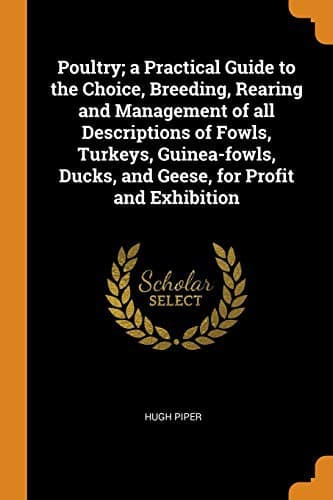
Poultry: A Practical Guide to the Choice, Breeding, Rearing, and Management of all Descriptions of Fowls, Turkeys, Guinea-fowls, Ducks, and Geese, for Profit and Exhibition.Piper, Hugh
Science
Poultry: A Practical Guide to the Choice, Breeding, Rearing, and Management of all Descriptions of Fowls, Turkeys, Guinea-fowls, Ducks, and Geese, for Profit and Exhibition.
Piper, Hugh
Poultry -- Breeding
If they are not out in a few hours after the shell has been broken, and
the hole is not enlarged, they are probably glued to the shell. Look
through the egg then, and, if all the yolk has passed into the body of
the chicken, you may assist it by enlarging the fracture with a pair of
fine scissors, cutting up towards the large end of the egg, never
downwards. "If," says Miss Watts, "the time has arrived when the chicken
may with safety be liberated, there will be no appearance of blood in
the minute blood-vessels spread over the interior of the shell; they
have done their work, and are no longer needed by the now fully
developed and breathing chick. If there should be the slightest
appearance of blood, resist at once, for its escape would generally be
fatal. Do not attempt to let the chicken out at once, but help it a
little every two or three hours. The object is not to hurry the chicken
out of its shell, but to prevent its being suffocated by being close
shut up within it. If the chick is tolerably strong, and the assistance
needful, it will aid its deliverance with its own exertions." When the
chicken at last makes its way out, do not interfere with it in any way,
or attempt to feed it. Animal heat alone can restore it. Weakness has
caused the delay, and this has probably arisen from insufficient warmth,
perhaps from the hen having had too many eggs to cover thoroughly, or
they may have been stale when set. Should you have to assist it out of
the shell, take it out gently with your fingers, taking great care not
to tear any of its tender skin, when freeing the feathers from the
shell.
Mr. Wright says: "We never ourselves now attempt to assist a chick from
the shell. If the eggs were fresh, and proper care has been taken to
preserve moisture during incubation, no assistance is ever needed. To
fuss about the nest frets the hen exceedingly; and we have always found
that, even where the poor little creature survived at the time, it never
lived to maturity. Should the reader attempt such assistance, in cases
where an egg has been long chipped, and no further progress made, let
the shell be cracked gently all round, without tearing the inside
membrane; if that be perforated, the viscid fluid inside dries and glues
the chick to the shell. Should this happen, or should both shell and
membrane be perforated at first, introduce the point of a pair of
scissors and cut up the egg towards the large end, where there will be
an empty space, remembering that, if blood flows, all hope is at end.
Then put the chick back under the hen; she will probably squeeze it to
death, it is true--it is so very weak; but it will never live if put by
the fire, at least we always found it so. Indeed, as we have said, we
consider it quite useless to make the attempt at all."
The fact is, it is scarcely worth while to attempt to assist in the case
of ordinary eggs, but if the breed is valuable the labour may be well
bestowed.
Public-domain text, read in full here on John Shaqi.
Reviews
Reviews
No reviews yet
Be the first to share your thoughts on this work.
Elsewhere in the archive
Join the Discussion
Join the discussion
Sign in to leave a comment or review.
Sign InorCreate an account