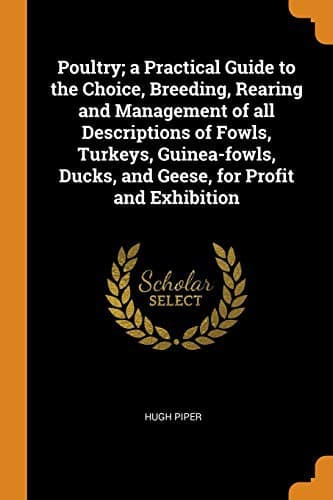
Poultry: A Practical Guide to the Choice, Breeding, Rearing, and Management of all Descriptions of Fowls, Turkeys, Guinea-fowls, Ducks, and Geese, for Profit and Exhibition.Piper, Hugh
Science
Poultry: A Practical Guide to the Choice, Breeding, Rearing, and Management of all Descriptions of Fowls, Turkeys, Guinea-fowls, Ducks, and Geese, for Profit and Exhibition.
Piper, Hugh
Poultry -- Breeding
"It becomes," says Miss Harriet Martineau, "an interesting wonder every
year why the rural cottagers of the United Kingdom do not rear fowls
almost universally, seeing how little the cost would be and how great
the demand. We import many millions of eggs annually. Why should we
import any? Wherever there is a cottage family living on potatoes or
better fare, and grass growing anywhere near them, it would be worth
while to nail up a little penthouse, and make nests of clean straw, and
go in for a speculation in eggs and chickens. Seeds, worms, and insects
go a great way in feeding poultry in such places; and then there are the
small and refuse potatoes from the heap, and the outside cabbage leaves,
and the scraps of all sorts. Very small purchases of broken rice (which
is extremely cheap), inferior grain, and mixed meal, would do all else
that is necessary. There would be probably larger losses from vermin
than in better guarded places; but these could be well afforded as a
mere deduction from considerable gains. It is understood that the
keeping of poultry is largely on the increase in the country generally,
and even among cottagers; but the prevailing idea is of competition as
to races and specimens for the poultry-yard, rather than of meeting the
demand for eggs and fowls for the table."
With the exception of prizes for Dorkings, which are chiefly bred for
market, our poultry-shows have always looked upon fowls as if they were
merely ornamental birds, and have framed their standards of excellence
accordingly, and not with any regard to the production of profitable
poultry, which is much to be regretted.
Martin Doyle, the cottage economist of Ireland, in his "Hints to Small
Holders," observes that "a few cocks and hens, if they be prevented from
scratching in the garden, are a useful and appropriate stock about a
cottage, the warmth of which causes them to lay eggs in winter--no
trifling advantage to the children when milk is scarce. The French, who
are extremely fond of eggs, and contrive to have them in great
abundance, feed the fowls so well on curds and buckwheat, and keep them
so warm, that they have plenty of eggs even in winter. Now, in our
country (Ireland), especially in a gentleman's fowl yard, there is not
an egg to be had in cold weather; but the warmth of the poor man's cabin
insures him an egg even in the most ungenial season."
Such fowls obtain fresh air, fresh grass, and fresh ground to scratch
in, and prosper in spite of the most miserable, puny, mongrel stock,
deteriorating year after year from breeding in and in, without the
introduction of fresh blood even of the same indifferent description.
Many an honest cottager might keep himself and family from the parish by
the aid of a small stock of poultry, if some kind poultry-keeper would
present him with two or three good fowls to begin with, for the cottager
has seldom capital even for so small a purchase.
Public-domain text, read in full here on John Shaqi.
Reviews
Reviews
No reviews yet
Be the first to share your thoughts on this work.
Join the Discussion
Join the discussion
Sign in to leave a comment or review.
Sign InorCreate an account