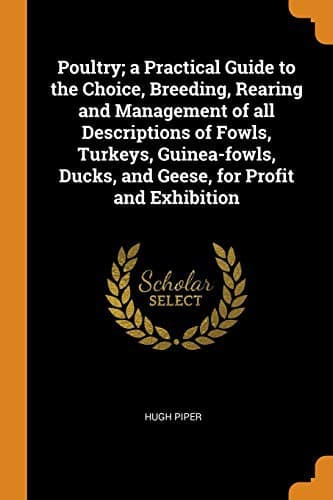
Poultry: A Practical Guide to the Choice, Breeding, Rearing, and Management of all Descriptions of Fowls, Turkeys, Guinea-fowls, Ducks, and Geese, for Profit and Exhibition.Piper, Hugh
Science
Poultry: A Practical Guide to the Choice, Breeding, Rearing, and Management of all Descriptions of Fowls, Turkeys, Guinea-fowls, Ducks, and Geese, for Profit and Exhibition.
Piper, Hugh
Poultry -- Breeding
The hen should be of good constitution and temper, and, if required to
sit, large in the body and wide in the wings, so as to cover many eggs
and shelter many chickens, but short in the legs, or she could not sit
well. M. Parmentier advises the rejection of savage, quarrelsome, or
peevish hens, as such are seldom favourites with the cocks, scarcely
ever lay, and do not hatch well; also all above four or five years of
age, those that are too fat to lay, and those whose combs and claws are
rough, which are signs that they have ceased to lay. Hens should not be
kept over their third year unless very good or choice. Hens are not
uncommon with the plumage and spurs of the cock, and which imitate,
though badly, his full-toned crow. In such fowls the power of producing
eggs is invariably lost from internal disease, as has been fully
demonstrated by Mr. Yarrell in the "Philosophical Transactions" for
1827, and in the "Proceedings of the Zoological Society" for 1831. Such
birds should be fattened and killed as soon as observed.
By careful study of the characteristics of the various breeds, breeding
from select specimens, and judicious crossing, great size may be
attained, maturity early developed, facility in putting on flesh
encouraged, hardiness of constitution and strength gained, and the
inclination to sit or the faculty of laying increased.
Sir John Sebright, speaking of breeding cattle, says: "Animals may be
said to be improved when any desired quality has been increased by art
beyond what that quality was in the same breed in a state of nature. The
swiftness of the racehorse, the propensity to fatten in cattle, and to
produce fine wool in sheep, are improvements which have been made in
particular varieties in the species to which these animals belong. What
has been produced by art must be continued by the same means, for the
most improved breeds will soon return to a state of nature, or perhaps
defects will arise which did not exist when the breed was in its natural
state, unless the greatest attention is paid to the selection of the
individuals who are to breed together."
Public-domain text, read in full here on John Shaqi.
Reviews
Reviews
No reviews yet
Be the first to share your thoughts on this work.
Elsewhere in the archive
Join the Discussion
Join the discussion
Sign in to leave a comment or review.
Sign InorCreate an account