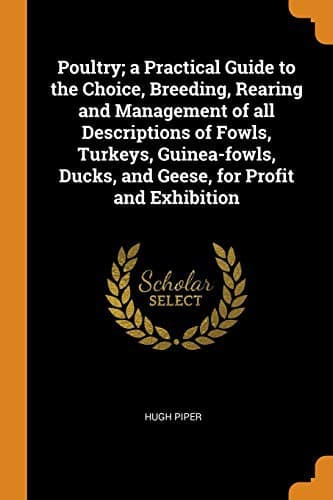
Poultry: A Practical Guide to the Choice, Breeding, Rearing, and Management of all Descriptions of Fowls, Turkeys, Guinea-fowls, Ducks, and Geese, for Profit and Exhibition.Piper, Hugh
Science
Poultry: A Practical Guide to the Choice, Breeding, Rearing, and Management of all Descriptions of Fowls, Turkeys, Guinea-fowls, Ducks, and Geese, for Profit and Exhibition.
Piper, Hugh
Poultry -- Breeding
In 1849, "the first poultry show that was ever held in 'the good old
town of Birmingham,' was beset with all the untried difficulties of such
a scheme, when without the experiences of the present day, then
altogether unavailable, a few spirited individuals carried to a
successful issue an event that has now proved the foster-parent of the
many others of similar character that abound in almost every principal
town of the United Kingdom. It is quite essential, that I may be clearly
understood, to preface my narrative by assuring fanciers that in those
former days poultry amateurs were by no means as general as at the
present time; few and far between were their locations; and though even
then, among the few who felt interest in fowls, emulation existed,
generally speaking, the keeping of poultry was regarded as 'a useless
hobby,' 'a mere individual caprice,' 'an idle whim from which no good
result could by possibility accrue'; nay, sometimes it was hinted, 'What
a pity they have not something better to employ them during leisure
hours!' and they were styled 'enthusiasts.' But have not the records of
every age proved that enthusiasts are invariably the pioneers of
improvement? And time, too, substantiated the verity of this rule in
reference to our subject; for, among other proofs, it brought
incontestable evidence that the raising of poultry was by no means the
unremunerative folly idlers supposed it to be, and hesitated not rashly
to declaim it; likewise, that it simply required to be fairly brought
under public notice, to prove its general utility, and to induce the
acknowledgment of how strangely so important a source of emolument had
been hitherto neglected and overlooked."
At the Birmingham Show of 1852, about five thousand fowls were
exhibited, and the specimens sold during the four days of the show
amounted to nearly two thousand pounds, notwithstanding the high prices
affixed to the pens, and that many were placed at enormous prices
amounting to a prohibition, the owners not wishing to sell them. The
Birmingham shows now generally comprise from one to two thousand pens of
fowls and water-fowls, arranged in nearly one hundred classes; besides
an equal proportion of pigeons. This show is the finest and most
important, but there are many others of very high character and great
extent. Poultry is also now exhibited to a considerable extent at
agricultural meetings.
Public-domain text, read in full here on John Shaqi.
Reviews
Reviews
No reviews yet
Be the first to share your thoughts on this work.
Elsewhere in the archive
Join the Discussion
Join the discussion
Sign in to leave a comment or review.
Sign InorCreate an account