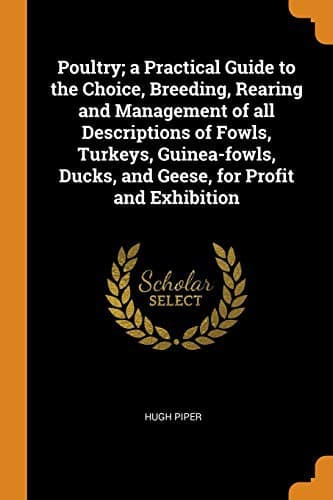
Poultry: A Practical Guide to the Choice, Breeding, Rearing, and Management of all Descriptions of Fowls, Turkeys, Guinea-fowls, Ducks, and Geese, for Profit and Exhibition.Piper, Hugh
Science
Poultry: A Practical Guide to the Choice, Breeding, Rearing, and Management of all Descriptions of Fowls, Turkeys, Guinea-fowls, Ducks, and Geese, for Profit and Exhibition.
Piper, Hugh
Poultry -- Breeding
Birds are frequently over-fed at the show, particularly with barley,
which cannot be properly digested for want of gravel and exercise; and
therefore, if upon their return their crops are hard and combs look
dark, give a tablespoonful of castor oil; but if they look well do not
interfere with them. They should not have any grain, but be fed
sparingly on stale bread soaked in warm ale, with two or three mouthfuls
of tepid water, for liquid is most hurtful if given in quantity. They
should not be put into the yard with the other fowls which may treat
them, after their absence, as intruders, but be joined with them at
night when the others have gone to roost. On the next day give them a
moderate allowance of soft food with a moderate supply of water, or
stale bread sopped in water, and a sod of grass or half a cabbage leaf
each, but no other green food; and on the following day they may have
their usual food.
When the fowls are brought back, take out the linings, wash them, and
put them by to be ready for the next show; and after the exhibition
season, on a fine dry day, wash the hampers, dry them thoroughly, and
put them in a dry place. Never use them as quiet berths for sick birds,
which are sure to infect them and cause the illness of the next
occupants; or as nesting-places for sitting hens, which may leave
insects in the crevices that will be difficult to eradicate.
In our descriptions of the various Breeds, we have given sufficient
general information upon the Exhibition Points from the best
authorities; but considerable differences of opinion have been expressed
of late years, and eminent breeders dissent in some cases even from the
generally recognised authority of the popular "Standard of Excellence."
We, therefore, advise intending exhibitors to ascertain the standards to
be followed at the show and the predilections of the judges, and to
breed accordingly, or, if they object to the views held, not to compete
at that exhibition.
TECHNICAL TERMS.
_Coverts._--The _upper_ and _lower wing coverts_ are those ranges of
feathers which cover the primary quills; and the _tail coverts_ are
those feathers growing on each side of the tail, and are longer than the
body feathers, but shorter than those of the tail.
_Dubbing._--Cutting off the comb and wattles of a cock; an operation
usually confined to Game cocks.
_Ear-lobe._--The small feathers covering the organ of hearing, which is
placed a little behind the eye.
_Flight._--The last five feathers of each wing.
_Fluff._--The silky feathers growing on the thighs and hinder parts of
Cochin-China fowls.
_Hackles._--The _neck hackles_ are feathers growing from the neck, and
covering the shoulders and part of the back; and the _saddle hackles_
those growing from the end of the back, and falling over the sides.
_Legs._--The _legs_ are properly the lower and scaly limbs, the upper
part covered with feathers and frequently mis-called legs, being
correctly styled the _thighs_.
Public-domain text, read in full here on John Shaqi.
Reviews
Reviews
No reviews yet
Be the first to share your thoughts on this work.
Elsewhere in the archive
Join the Discussion
Join the discussion
Sign in to leave a comment or review.
Sign InorCreate an account