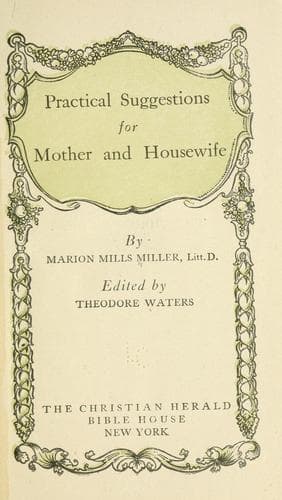
Practical Suggestions for Mother and HousewifeMiller, Marion Mills
Philosophy
Practical Suggestions for Mother and Housewife
Miller, Marion Mills
Home economics
On the other hand, marriage for love to a man who cannot support her is
a sad mistake for a woman who is not able or willing to take the place
of breadwinner, for such a union defeats its own purpose. Therefore,
in kindness to the man as well as to herself, such a woman should satisfy
herself that he can support her, not necessarily in "the style to which
she has been accustomed," but in the style necessary for her to perform
the duties of homemaker and mother. Those marriages are the happiest
where a wife can also enter into sympathy with her husband's business
ambitions in particular and ideals of life in general. Here she is
peculiarly his helpmate. He can hire a housekeeper, but not a companion
of his bosom.
A girl properly reared will naturally be drawn to a man complementary
to her in character--not "opposite," as is so often said. Opposition
implies antagonism, which would be the ruin of home life. The term
complementary implies similarity in the main elements of character with
adaptable differences. Good qualities, such as strength and delicacy,
may complement each other, but not evil and good qualities, such as
brutality and tenderness. As Scott says in the quotation at the head
of this chapter, a tender wife may suit the taste of a churlish husband,
but only by not long surviving his unkindness. While such opposition may
not result in actual death, it certainly leads to the demise of all that
makes life worth living.
A woman should not expect to find a perfect husband. Indeed, her chief
usefulness to him will be in her strengthening his weak points, and
cultivating his right inclinations until they are confirmed habits.
Yet in this work she should realize the imperfections in herself, and
respond to the similar aid he gives her by his example and suggestions.
Mutual aid is the great bond of marriage, as it is of all human
relations.
Women, from their weaker condition, have from ages past been trained to
gain their desires from men by indirection. In the worst form, this
appears as deceit; in the best, as tact. Laying aside the moral aspect,
deceit is always unwise in a wife, since, in time, it defeats its own
end. Many a woman thinks that she is deceiving her husband, since she
wins her points, when he thoroughly recognizes her machinations, and
accedes to them without contest simply for peace in the household,
acquiring a feeling of moral superiority to her which, though it may be
tolerant, is nevertheless contemptuous. But when she employs loving
tact, especially in the improvement of her husband's habits and traits,
even though he realizes it, he is at heart grateful for it, and proud
of his wife's superiority in these points.
Public-domain text, read in full here on John Shaqi.
Reviews
Reviews
No reviews yet
Be the first to share your thoughts on this work.
Join the Discussion
Join the discussion
Sign in to leave a comment or review.
Sign InorCreate an account