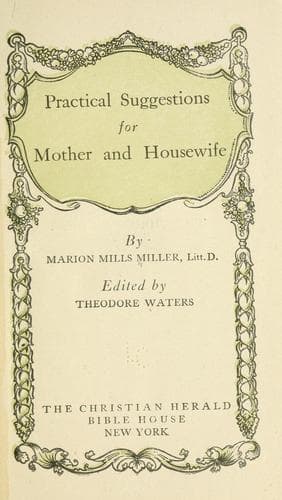
Practical Suggestions for Mother and HousewifeMiller, Marion Mills
Philosophy
Practical Suggestions for Mother and Housewife
Miller, Marion Mills
Home economics
In the large cities there is constant complaint of defective gas-meters,
so much so that inspectors have been appointed to correct this abuse.
It has been found, however, that many complaints have been unfounded
because the housewives were not able properly to read the meter.
Directions how to do this will therefore be found useful. A gas-meter
has three dials marking tip to 100,000 feet, 10,000 feet, and 1,000 feet
respectively. The figures on the second dial are arranged in opposite
order from those on the first and third dials, and this often leads to
an error in reckoning. However, there should be no trouble in setting
down the figures indicated by the pointer on each dial. We first set
down the figure indicated upon the first dial in the units place of a
period of three places, then that indicated upon the second dial in the
tens place, and then that indicated upon the third dial in the hundreds
place. To these we add two ciphers, to obtain the number of feet of gas
that has been burned since the meter was set at zero on the three dials.
From this number we subtract the total of feet burned at the time when
the preceding gas bill was rendered. This is generally called on the
bill "present state of meter." The result of the subtraction will be
the amount of gas that has been burned since the last bill was rendered.
For example:
95,300, amount indicated on dial.
82,700, amount marked "present state of meter" on preceding gas bill.
------
12,600, amount of gas for which current bill is rendered.
Equal care must be exercised when kerosene is used for illumination,
since, while it is not so dangerous directly to life, it is the chief
source of the destruction of property. Accordingly the nature of
kerosene and the way it illuminates is a profitable subject of study if
we would prevent destructive fires. Really, we do not burn the oil, but
the gas that arises from the oil when liberated by the burning wick and
becomes incandescent when fed by the oxygen of the air. While kerosene
requires a high temperature for combustion, it is closely related to
other products of coal oil, such as naphtha and gasoline, which become
inflammable at a low heat and are therefore very dangerous. Since the
cheap grades of kerosene approach these products in quality, care should
be taken to see that it is of high "proof" in order to prevent
explosions. The proof required of kerosene differs in various States;
that in some is as low as 100 degrees Fahrenheit, that is, the
temperature at which the oil will give off vapors that will ignite.
This is too low a proof, for such a degree of temperature is quite common
in the household. It is safe only to use that kerosene which is at least
140 degrees proof, for then, even though the oil is spilled, there is
little danger that it will ignite except in the immediate presence of
flame. There is no danger at all in soaking wood with this kind of oil
in a stove or grate wherein the fire has gone out.
Public-domain text, read in full here on John Shaqi.
Reviews
Reviews
No reviews yet
Be the first to share your thoughts on this work.
Join the Discussion
Join the discussion
Sign in to leave a comment or review.
Sign InorCreate an account