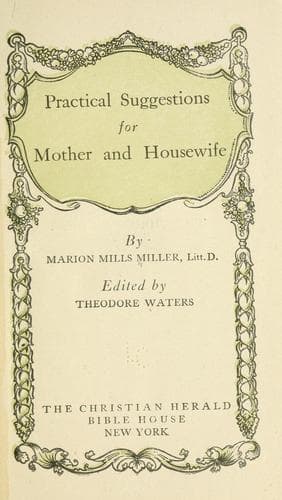
Practical Suggestions for Mother and Housewife — John Shaqi
Practical Suggestions for Mother and HousewifeMiller, Marion Mills
Philosophy
Practical Suggestions for Mother and Housewife
Miller, Marion Mills
Home economics
The supper of the school-child while young should be a simple one,
something on the order of the breakfast. In the early days children were
fed at night on hasty pudding, or mush-and-milk, (cornmeal), which is
an ideal food when thoroughly prepared, the meal being slowly sprinkled
into the pot, which was stirred constantly all the while. The North
Italians prepare cornmeal in this fashion; the mush, which they call
"polenta," forms an accompaniment of meat stews, thus affording all the
elements of a "perfect ration." American cooks should employ cornmeal
far more than they do. Mush in particular has the advantage possessed by
King Arthur's bag-pudding, what cannot be eaten at night may be served
"next morning fried." While fried food is, as a rule, not good at
breakfast for any save one who has hard manual labor or physical
exercise to perform, an exception may be made of fried mush and fried
eggs, because their base is so nutritious that the heated fat can do
little to impair their digestibility, while it certainly whets the
appetite before eating, and pleases the palate when the food is in the
mouth. It should be borne in mind that those foods which require much
mastication ought especially to be made palatable in order to be chewed
thoroughly. Therefore, starchy materials ought to be prepared in
appetizing ways; on the other hand, meats, which require less
mastication, may dispense with high seasoning and rich sauces,
especially as they have their own natural flavors.
The mother should closely follow the work of the child at school and
aid this in every way at home. She should patiently answer his many
questions, except when she is convinced that he is not really in search
of information, but is asking them merely for the sake of asking.
Wherever the child ought to be able to reason out the answer, the mother
should assist him to do so by asking him guiding questions in turn. This
is the method that Socrates, the greatest of teachers and philosophers,
employed with his pupils, and, indeed, with his own children. It is as
useful in inculcating moral lessons as in teaching facts. When one of
the sons of Socrates, Lamprocles, came to him complaining that the
mother, Xanthippe, treated him so hardly that he could not bear it, the
philosopher, by kindly questions, led the boy to acknowledge his great
debt to her for her care of him in infancy and in sickness, and, by
showing the many things Xanthippe had to try her patience, persuaded
him to bear with her and to give her that love which was her due.
Where manual training is taught in the schools, the mother should give
every opportunity to her children to practice it at home. Where it is
not a part of the school course, parents should study to devise home
substitutes for it, the mother teaching the girls sewing, embroidery,
etc., and the father instructing the boys in carpentry and the like.
Public-domain text, read in full here on John Shaqi.
Reviews
Reviews
No reviews yet
Be the first to share your thoughts on this work.
Join the Discussion
Join the discussion
Sign in to leave a comment or review.
Sign InorCreate an account