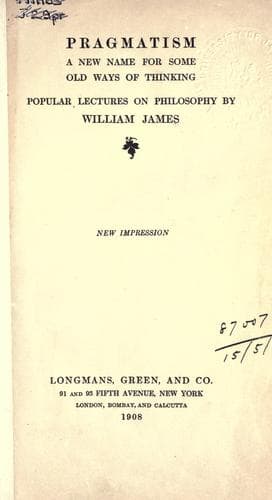
Pragmatism: A New Name for Some Old Ways of ThinkingJames, William
Philosophy
Pragmatism: A New Name for Some Old Ways of Thinking
James, William
Pragmatism
What shall we call a THING anyhow? It seems quite arbitrary, for we
carve out everything, just as we carve out constellations, to suit our
human purposes. For me, this whole 'audience' is one thing, which grows
now restless, now attentive. I have no use at present for its individual
units, so I don't consider them. So of an 'army,' of a 'nation.' But
in your own eyes, ladies and gentlemen, to call you 'audience' is an
accidental way of taking you. The permanently real things for you are
your individual persons. To an anatomist, again, those persons are but
organisms, and the real things are the organs. Not the organs, so much
as their constituent cells, say the histologists; not the cells, but
their molecules, say in turn the chemists.
We break the flux of sensible reality into things, then, at our will. We
create the subjects of our true as well as of our false propositions.
We create the predicates also. Many of the predicates of things express
only the relations of the things to us and to our feelings. Such
predicates of course are human additions. Caesar crossed the Rubicon,
and was a menace to Rome's freedom. He is also an American school-room
pest, made into one by the reaction of our schoolboys on his writings.
The added predicate is as true of him as the earlier ones.
You see how naturally one comes to the humanistic principle: you can't
weed out the human contribution. Our nouns and adjectives are all
humanized heirlooms, and in the theories we build them into, the inner
order and arrangement is wholly dictated by human considerations,
intellectual consistency being one of them. Mathematics and logic
themselves are fermenting with human rearrangements; physics, astronomy
and biology follow massive cues of preference. We plunge forward into
the field of fresh experience with the beliefs our ancestors and we have
made already; these determine what we notice; what we notice determines
what we do; what we do again determines what we experience; so from
one thing to another, altho the stubborn fact remains that there IS a
sensible flux, what is true of it seems from first to last to be largely
a matter of our own creation.
We build the flux out inevitably. The great question is: does it,
with our additions, rise or fall in value? Are the additions WORTHY or
UNWORTHY? Suppose a universe composed of seven stars, and nothing else
but three human witnesses and their critic. One witness names the
stars 'Great Bear'; one calls them 'Charles's Wain'; one calls them the
'Dipper.' Which human addition has made the best universe of the given
stellar material? If Frederick Myers were the critic, he would have no
hesitation in 'turning-down' the American witness.
Public-domain text, read in full here on John Shaqi.
Reviews
Reviews
No reviews yet
Be the first to share your thoughts on this work.
Elsewhere in the archive
Join the Discussion
Join the discussion
Sign in to leave a comment or review.
Sign InorCreate an account