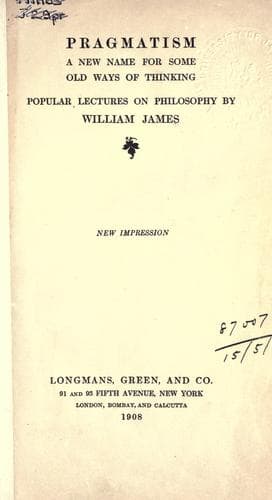
Pragmatism: A New Name for Some Old Ways of ThinkingJames, William
Philosophy
Pragmatism: A New Name for Some Old Ways of Thinking
James, William
Pragmatism
Lotze has in several places made a deep suggestion. We naively assume,
he says, a relation between reality and our minds which may be just the
opposite of the true one. Reality, we naturally think, stands ready-made
and complete, and our intellects supervene with the one simple duty
of describing it as it is already. But may not our descriptions, Lotze
asks, be themselves important additions to reality? And may not previous
reality itself be there, far less for the purpose of reappearing
unaltered in our knowledge, than for the very purpose of stimulating
our minds to such additions as shall enhance the universe's total value.
"Die erhohung des vorgefundenen daseins" is a phrase used by Professor
Eucken somewhere, which reminds one of this suggestion by the great
Lotze.
It is identically our pragmatistic conception. In our cognitive as well
as in our active life we are creative. We ADD, both to the subject and
to the predicate part of reality. The world stands really malleable,
waiting to receive its final touches at our hands. Like the kingdom of
heaven, it suffers human violence willingly. Man ENGENDERS truths upon
it.
No one can deny that such a role would add both to our dignity and to
our responsibility as thinkers. To some of us it proves a most inspiring
notion. Signer Papini, the leader of italian pragmatism, grows fairly
dithyrambic over the view that it opens, of man's divinely-creative
functions.
The import of the difference between pragmatism and rationalism is now
in sight throughout its whole extent. The essential contrast is that for
rationalism reality is ready-made and complete from all eternity,
while for pragmatism it is still in the making, and awaits part of its
complexion from the future. On the one side the universe is absolutely
secure, on the other it is still pursuing its adventures.
We have got into rather deep water with this humanistic view, and it is
no wonder that misunderstanding gathers round it. It is accused of being
a doctrine of caprice. Mr. Bradley, for example, says that a humanist,
if he understood his own doctrine, would have to "hold any end however
perverted to be rational if I insist on it personally, and any idea
however mad to be the truth if only some one is resolved that he will
have it so." The humanist view of 'reality,' as something resisting, yet
malleable, which controls our thinking as an energy that must be
taken 'account' of incessantly (tho not necessarily merely COPIED) is
evidently a difficult one to introduce to novices. The situation reminds
me of one that I have personally gone through. I once wrote an essay on
our right to believe, which I unluckily called the WILL to Believe.
All the critics, neglecting the essay, pounced upon the title.
Psychologically it was impossible, morally it was iniquitous. The
"will to deceive," the "will to make-believe," were wittily proposed as
substitutes for it.
Public-domain text, read in full here on John Shaqi.
Reviews
Reviews
No reviews yet
Be the first to share your thoughts on this work.
Elsewhere in the archive
Join the Discussion
Join the discussion
Sign in to leave a comment or review.
Sign InorCreate an account