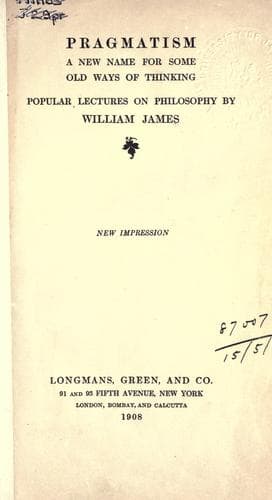
Pragmatism: A New Name for Some Old Ways of ThinkingJames, William
Philosophy
Pragmatism: A New Name for Some Old Ways of Thinking
James, William
Pragmatism
THE ALTERNATIVE BETWEEN PRAGMATISM AND RATIONALISM, IN THE SHAPE IN
WHICH WE NOW HAVE IT BEFORE US, IS NO LONGER A QUESTION IN THE THEORY OF
KNOWLEDGE, IT CONCERNS THE STRUCTURE OF THE UNIVERSE ITSELF.
On the pragmatist side we have only one edition of the universe,
unfinished, growing in all sorts of places, especially in the places
where thinking beings are at work.
On the rationalist side we have a universe in many editions, one real
one, the infinite folio, or edition de luxe, eternally complete; and
then the various finite editions, full of false readings, distorted and
mutilated each in its own way.
So the rival metaphysical hypotheses of pluralism and monism here come
back upon us. I will develope their differences during the remainder of
our hour.
And first let me say that it is impossible not to see a temperamental
difference at work in the choice of sides. The rationalist mind,
radically taken, is of a doctrinaire and authoritative complexion: the
phrase 'must be' is ever on its lips. The belly-band of its
universe must be tight. A radical pragmatist on the other hand is a
happy-go-lucky anarchistic sort of creature. If he had to live in a tub
like Diogenes he wouldn't mind at all if the hoops were loose and the
staves let in the sun.
Now the idea of this loose universe affects your typical rationalists
in much the same way as 'freedom of the press' might affect a veteran
official in the russian bureau of censorship; or as 'simplified
spelling' might affect an elderly schoolmistress. It affects him as
the swarm of protestant sects affects a papist onlooker. It appears
as backboneless and devoid of principle as 'opportunism' in politics
appears to an old-fashioned french legitimist, or to a fanatical
believer in the divine right of the people.
For pluralistic pragmatism, truth grows up inside of all the finite
experiences. They lean on each other, but the whole of them, if such a
whole there be, leans on nothing. All 'homes' are in finite experience;
finite experience as such is homeless. Nothing outside of the flux
secures the issue of it. It can hope salvation only from its own
intrinsic promises and potencies.
Public-domain text, read in full here on John Shaqi.
Reviews
Reviews
No reviews yet
Be the first to share your thoughts on this work.
Elsewhere in the archive
Join the Discussion
Join the discussion
Sign in to leave a comment or review.
Sign InorCreate an account