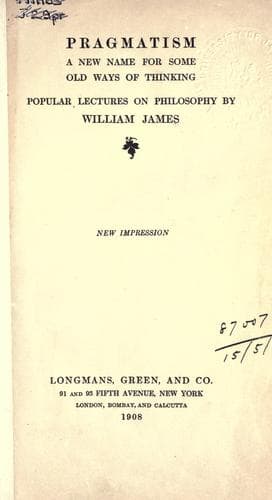
Pragmatism: A New Name for Some Old Ways of ThinkingJames, William
Philosophy
Pragmatism: A New Name for Some Old Ways of Thinking
James, William
Pragmatism
And this, exactly this, is what the tough-minded of that lecture find
themselves moved to call a piece of perverse abstraction-worship. The
tough-minded are the men whose alpha and omega are FACTS. Behind the
bare phenomenal facts, as my tough-minded old friend Chauncey Wright,
the great Harvard empiricist of my youth, used to say, there is NOTHING.
When a rationalist insists that behind the facts there is the GROUND of
the facts, the POSSIBILITY of the facts, the tougher empiricists accuse
him of taking the mere name and nature of a fact and clapping it behind
the fact as a duplicate entity to make it possible. That such sham
grounds are often invoked is notorious. At a surgical operation I heard
a bystander ask a doctor why the patient breathed so deeply. "Because
ether is a respiratory stimulant," the doctor answered. "Ah!" said the
questioner, as if relieved by the explanation. But this is like saying
that cyanide of potassium kills because it is a 'poison,' or that it is
so cold to-night because it is 'winter,' or that we have five fingers
because we are 'pentadactyls.' These are but names for the facts,
taken from the facts, and then treated as previous and explanatory.
The tender-minded notion of an absolute reality is, according to the
radically tough-minded, framed on just this pattern. It is but our
summarizing name for the whole spread-out and strung-along mass of
phenomena, treated as if it were a different entity, both one and
previous.
You see how differently people take things. The world we live in exists
diffused and distributed, in the form of an indefinitely numerous lot of
eaches, coherent in all sorts of ways and degrees; and the tough-minded
are perfectly willing to keep them at that valuation. They can stand
that kind of world, their temper being well adapted to its insecurity.
Not so the tender-minded party. They must back the world we find
ourselves born into by "another and a better" world in which the eaches
form an All and the All a One that logically presupposes, co-implicates,
and secures each EACH without exception.
Must we as pragmatists be radically tough-minded? or can we treat
the absolute edition of the world as a legitimate hypothesis? It is
certainly legitimate, for it is thinkable, whether we take it in its
abstract or in its concrete shape.
Public-domain text, read in full here on John Shaqi.
Reviews
Reviews
No reviews yet
Be the first to share your thoughts on this work.
Elsewhere in the archive
Join the Discussion
Join the discussion
Sign in to leave a comment or review.
Sign InorCreate an account