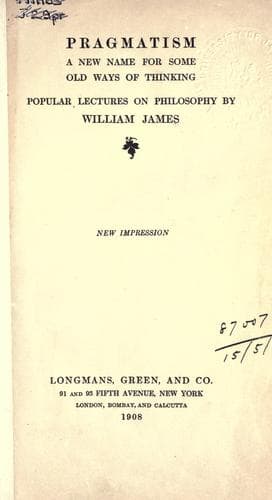
Pragmatism: A New Name for Some Old Ways of ThinkingJames, William
Philosophy
Pragmatism: A New Name for Some Old Ways of Thinking
James, William
Pragmatism
How is such a conception of the pragmatism I am advocating possible,
after my first and second lectures? I have all along been offering it
expressly as a mediator between tough-mindedness and tender-mindedness.
If the notion of a world ante rem, whether taken abstractly like the
word winter, or concretely as the hypothesis of an Absolute, can be
shown to have any consequences whatever for our life, it has a meaning.
If the meaning works, it will have SOME truth that ought to be held to
through all possible reformulations, for pragmatism.
The absolutistic hypothesis, that perfection is eternal, aboriginal, and
most real, has a perfectly definite meaning, and it works religiously.
To examine how, will be the subject of my next and final lecture.
Lecture VIII
Pragmatism and Religion
At the close of the last lecture I reminded you of the first one,
in which I had opposed tough-mindedness to tender-mindedness and
recommended pragmatism as their mediator. Tough-mindedness positively
rejects tender-mindedness's hypothesis of an eternal perfect edition of
the universe coexisting with our finite experience.
On pragmatic principles we cannot reject any hypothesis if consequences
useful to life flow from it. Universal conceptions, as things to take
account of, may be as real for pragmatism as particular sensations are.
They have indeed no meaning and no reality if they have no use. But if
they have any use they have that amount of meaning. And the meaning will
be true if the use squares well with life's other uses.
Well, the use of the Absolute is proved by the whole course of
men's religious history. The eternal arms are then beneath. Remember
Vivekananda's use of the Atman: it is indeed not a scientific use,
for we can make no particular deductions from it. It is emotional and
spiritual altogether.
It is always best to discuss things by the help of concrete examples.
Let me read therefore some of those verses entitled "To You" by Walt
Whitman--"You" of course meaning the reader or hearer of the poem
whosoever he or she may be.
Whoever you are, now I place my hand upon you, that you be my poem; I
whisper with my lips close to your ear, I have loved many women and men,
but I love none better than you.
O I have been dilatory and dumb; I should have made my way straight
to you long ago; I should have blabb'd nothing but you, I should have
chanted nothing but you.
I will leave all, and come and make the hymns of you; None have
understood you, but I understand you; None have done justice to you--you
have not done justice to yourself; None but have found you imperfect--I
only find no imperfection in you.
O I could sing such grandeurs and glories about you! You have not known
what you are--you have slumber'd upon yourself all your life; What you
have done returns already in mockeries.
Public-domain text, read in full here on John Shaqi.
Reviews
Reviews
No reviews yet
Be the first to share your thoughts on this work.
Elsewhere in the archive
Join the Discussion
Join the discussion
Sign in to leave a comment or review.
Sign InorCreate an account