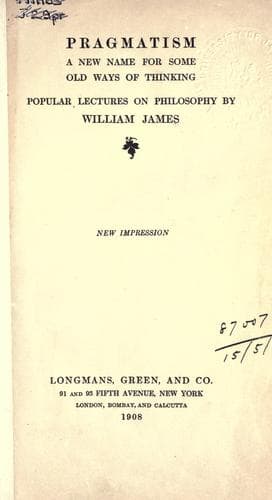
Pragmatism: A New Name for Some Old Ways of ThinkingJames, William
Philosophy
Pragmatism: A New Name for Some Old Ways of Thinking
James, William
Pragmatism
We cannot therefore methodically join the tough minds in their rejection
of the whole notion of a world beyond our finite experience. One
misunderstanding of pragmatism is to identify it with positivistic
tough-mindedness, to suppose that it scorns every rationalistic notion
as so much jabber and gesticulation, that it loves intellectual anarchy
as such and prefers a sort of wolf-world absolutely unpent and wild
and without a master or a collar to any philosophic class-room
product, whatsoever. I have said so much in these lectures against
the over-tender forms of rationalism, that I am prepared for some
misunderstanding here, but I confess that the amount of it that I have
found in this very audience surprises me, for I have simultaneously
defended rationalistic hypotheses so far as these re-direct you
fruitfully into experience.
For instance I receive this morning this question on a post-card: "Is a
pragmatist necessarily a complete materialist and agnostic?" One of my
oldest friends, who ought to know me better, writes me a letter that
accuses the pragmatism I am recommending, of shutting out all wider
metaphysical views and condemning us to the most terre-a-terre
naturalism. Let me read you some extracts from it.
"It seems to me," my friend writes, "that the pragmatic objection to
pragmatism lies in the fact that it might accentuate the narrowness of
narrow minds.
"Your call to the rejection of the namby-pamby and the wishy-washy is of
course inspiring. But although it is salutary and stimulating to be told
that one should be responsible for the immediate issues and bearings
of his words and thoughts, I decline to be deprived of the pleasure and
profit of dwelling also on remoter bearings and issues, and it is the
TENDENCY of pragmatism to refuse this privilege.
"In short, it seems to me that the limitations, or rather the dangers,
of the pragmatic tendency, are analogous to those which beset the unwary
followers of the 'natural sciences.' Chemistry and physics are eminently
pragmatic and many of their devotees, smugly content with the data that
their weights and measures furnish, feel an infinite pity and disdain
for all students of philosophy and meta-physics, whomsoever. And
of course everything can be expressed--after a fashion, and
'theoretically'--in terms of chemistry and physics, that is, EVERYTHING
EXCEPT THE VITAL PRINCIPLE OF THE WHOLE, and that, they say, there is no
pragmatic use in trying to express; it has no bearings--FOR THEM. I for
my part refuse to be persuaded that we cannot look beyond the obvious
pluralism of the naturalist and the pragmatist to a logical unity in
which they take no interest."
Public-domain text, read in full here on John Shaqi.
Reviews
Reviews
No reviews yet
Be the first to share your thoughts on this work.
Elsewhere in the archive
Join the Discussion
Join the discussion
Sign in to leave a comment or review.
Sign InorCreate an account