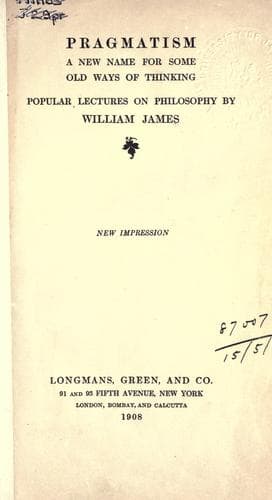
Pragmatism: A New Name for Some Old Ways of ThinkingJames, William
Philosophy
Pragmatism: A New Name for Some Old Ways of Thinking
James, William
Pragmatism
In either way of taking the poem, it encourages fidelity to ourselves.
Both ways satisfy; both sanctify the human flux. Both paint the portrait
of the YOU on a gold-background. But the background of the first way
is the static One, while in the second way it means possibles in the
plural, genuine possibles, and it has all the restlessness of that
conception.
Noble enough is either way of reading the poem; but plainly the
pluralistic way agrees with the pragmatic temper best, for it
immediately suggests an infinitely larger number of the details of
future experience to our mind. It sets definite activities in us at
work. Altho this second way seems prosaic and earthborn in comparison
with the first way, yet no one can accuse it of tough-mindedness in any
brutal sense of the term. Yet if, as pragmatists, you should positively
set up the second way AGAINST the first way, you would very likely be
misunderstood. You would be accused of denying nobler conceptions, and
of being an ally of tough-mindedness in the worst sense.
You remember the letter from a member of this audience from which I read
some extracts at our previous meeting. Let me read you an additional
extract now. It shows a vagueness in realizing the alternatives before
us which I think is very widespread.
"I believe," writes my friend and correspondent, "in pluralism; I
believe that in our search for truth we leap from one floating cake of
ice to another, on an infinite sea, and that by each of our acts we make
new truths possible and old ones impossible; I believe that each man is
responsible for making the universe better, and that if he does not do
this it will be in so far left undone.
"Yet at the same time I am willing to endure that my children should be
incurably sick and suffering (as they are not) and I myself stupid
and yet with brains enough to see my stupidity, only on one condition,
namely, that through the construction, in imagination and by reasoning,
of a RATIONAL UNITY OF ALL THINGS, I can conceive my acts and my
thoughts and my troubles as SUPPLEMENTED: BY ALL THE OTHER PHENOMENA
OF THE WORLD, AND AS FORMING--WHEN THUS SUPPLEMENTED--A SCHEME WHICH I
APPROVE AND ADOPT AS MY I OWN; and for my part I refuse to be persuaded
that we cannot look beyond the obvious pluralism of the naturalist and
pragmatist to a logical unity in which they take no interest or stock."
Such a fine expression of personal faith warms the heart of the hearer.
But how much does it clear his philosophic head? Does the writer
consistently favor the monistic, or the pluralistic, interpretation of
the world's poem? His troubles become atoned for WHEN THUS SUPPLEMENTED,
he says, supplemented, that is, by all the remedies that THE OTHER
PHENOMENA may supply. Obviously here the writer faces forward into
the particulars of experience, which he interprets in a
pluralistic-melioristic way.
Public-domain text, read in full here on John Shaqi.
Reviews
Reviews
No reviews yet
Be the first to share your thoughts on this work.
Elsewhere in the archive
Join the Discussion
Join the discussion
Sign in to leave a comment or review.
Sign InorCreate an account