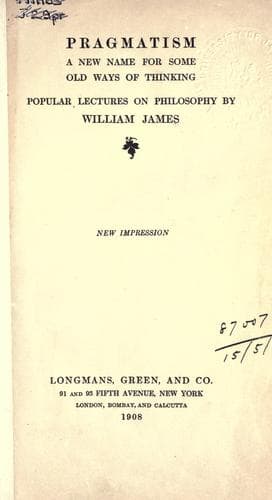
Pragmatism: A New Name for Some Old Ways of ThinkingJames, William
Philosophy
Pragmatism: A New Name for Some Old Ways of Thinking
James, William
Pragmatism
But he believes himself to face backward. He speaks of what he calls
the rational UNITY of things, when all the while he really means their
possible empirical UNIFICATION. He supposes at the same time that the
pragmatist, because he criticizes rationalism's abstract One, is cut
off from the consolation of believing in the saving possibilities of
the concrete many. He fails in short to distinguish between taking the
world's perfection as a necessary principle, and taking it only as a
possible terminus ad quem.
I regard the writer of this letter as a genuine pragmatist, but as a
pragmatist sans le savoir. He appears to me as one of that numerous
class of philosophic amateurs whom I spoke of in my first lecture, as
wishing to have all the good things going, without being too careful
as to how they agree or disagree. "Rational unity of all things" is
so inspiring a formula, that he brandishes it offhand, and abstractly
accuses pluralism of conflicting with it (for the bare names do
conflict), altho concretely he means by it just the pragmatistically
unified and ameliorated world. Most of us remain in this essential
vagueness, and it is well that we should; but in the interest of
clear-headedness it is well that some of us should go farther, so I
will try now to focus a little more discriminatingly on this particular
religious point.
Is then this you of yous, this absolutely real world, this unity that
yields the moral inspiration and has the religious value, to be taken
monistically or pluralistically? Is it ante rem or in rebus? Is it a
principle or an end, an absolute or an ultimate, a first or a last? Does
it make you look forward or lie back? It is certainly worth while not to
clump the two things together, for if discriminated, they have decidedly
diverse meanings for life.
Please observe that the whole dilemma revolves pragmatically about the
notion of the world's possibilities. Intellectually, rationalism invokes
its absolute principle of unity as a ground of possibility for the
many facts. Emotionally, it sees it as a container and limiter of
possibilities, a guarantee that the upshot shall be good. Taken in this
way, the absolute makes all good things certain, and all bad things
impossible (in the eternal, namely), and may be said to transmute the
entire category of possibility into categories more secure. One sees at
this point that the great religious difference lies between the men who
insist that the world MUST AND SHALL BE, and those who are contented
with believing that the world MAY BE, saved. The whole clash of
rationalistic and empiricist religion is thus over the validity of
possibility. It is necessary therefore to begin by focusing upon that
word. What may the word 'possible' definitely mean?
Public-domain text, read in full here on John Shaqi.
Reviews
Reviews
No reviews yet
Be the first to share your thoughts on this work.
Elsewhere in the archive
Join the Discussion
Join the discussion
Sign in to leave a comment or review.
Sign InorCreate an account