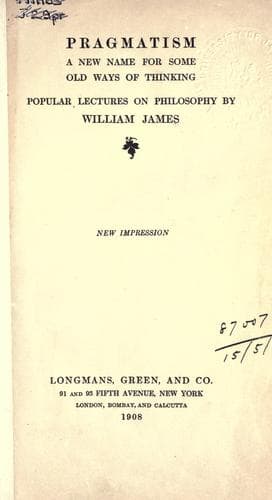
Pragmatism: A New Name for Some Old Ways of ThinkingJames, William
Philosophy
Pragmatism: A New Name for Some Old Ways of Thinking
James, William
Pragmatism
But this talk of rationality is a parenthesis and a digression. What
we were discussing was the idea of a world growing not integrally but
piecemeal by the contributions of its several parts. Take the hypothesis
seriously and as a live one. Suppose that the world's author put the
case to you before creation, saying: "I am going to make a world
not certain to be saved, a world the perfection of which shall be
conditional merely, the condition being that each several agent does its
own 'level best.' I offer you the chance of taking part in such a world.
Its safety, you see, is unwarranted. It is a real adventure, with real
danger, yet it may win through. It is a social scheme of co-operative
work genuinely to be done. Will you join the procession? Will you trust
yourself and trust the other agents enough to face the risk?"
Should you in all seriousness, if participation in such a world were
proposed to you, feel bound to reject it as not safe enough? Would you
say that, rather than be part and parcel of so fundamentally pluralistic
and irrational a universe, you preferred to relapse into the slumber of
nonentity from which you had been momentarily aroused by the tempter's
voice?
Of course if you are normally constituted, you would do nothing of the
sort. There is a healthy-minded buoyancy in most of us which such a
universe would exactly fit. We would therefore accept the offer--"Top!
und schlag auf schlag!" It would be just like the world we practically
live in; and loyalty to our old nurse Nature would forbid us to say no.
The world proposed would seem 'rational' to us in the most living way.
Most of us, I say, would therefore welcome the proposition and add our
fiat to the fiat of the creator. Yet perhaps some would not; for there
are morbid minds in every human collection, and to them the prospect of
a universe with only a fighting chance of safety would probably make no
appeal. There are moments of discouragement in us all, when we are sick
of self and tired of vainly striving. Our own life breaks down, and we
fall into the attitude of the prodigal son. We mistrust the chances
of things. We want a universe where we can just give up, fall on our
father's neck, and be absorbed into the absolute life as a drop of water
melts into the river or the sea.
The peace and rest, the security desiderated at such moments is security
against the bewildering accidents of so much finite experience. Nirvana
means safety from this everlasting round of adventures of which the
world of sense consists. The hindoo and the buddhist, for this
is essentially their attitude, are simply afraid, afraid of more
experience, afraid of life.
Public-domain text, read in full here on John Shaqi.
Reviews
Reviews
No reviews yet
Be the first to share your thoughts on this work.
Elsewhere in the archive
Join the Discussion
Join the discussion
Sign in to leave a comment or review.
Sign InorCreate an account