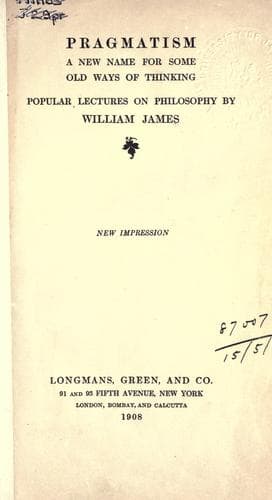
Pragmatism: A New Name for Some Old Ways of ThinkingJames, William
Philosophy
Pragmatism: A New Name for Some Old Ways of Thinking
James, William
Pragmatism
And to men of this complexion, religious monism comes with its consoling
words: "All is needed and essential--even you with your sick soul and
heart. All are one with God, and with God all is well. The everlasting
arms are beneath, whether in the world of finite appearances you seem to
fail or to succeed." There can be no doubt that when men are reduced
to their last sick extremity absolutism is the only saving scheme.
Pluralistic moralism simply makes their teeth chatter, it refrigerates
the very heart within their breast.
So we see concretely two types of religion in sharp contrast. Using our
old terms of comparison, we may say that the absolutistic scheme appeals
to the tender-minded while the pluralistic scheme appeals to the tough.
Many persons would refuse to call the pluralistic scheme religious at
all. They would call it moralistic, and would apply the word religious
to the monistic scheme alone. Religion in the sense of self-surrender,
and moralism in the sense of self-sufficingness, have been pitted
against each other as incompatibles frequently enough in the history of
human thought.
We stand here before the final question of philosophy. I said in my
fourth lecture that I believed the monistic-pluralistic alternative to
be the deepest and most pregnant question that our minds can frame. Can
it be that the disjunction is a final one? that only one side can be
true? Are a pluralism and monism genuine incompatibles? So that, if
the world were really pluralistically constituted, if it really existed
distributively and were made up of a lot of eaches, it could only be
saved piecemeal and de facto as the result of their behavior, and its
epic history in no wise short-circuited by some essential oneness in
which the severalness were already 'taken up' beforehand and eternally
'overcome'? If this were so, we should have to choose one philosophy or
the other. We could not say 'yes, yes' to both alternatives. There would
have to be a 'no' in our relations with the possible. We should confess
an ultimate disappointment: we could not remain healthy-minded and
sick-minded in one indivisible act.
Public-domain text, read in full here on John Shaqi.
Reviews
Reviews
No reviews yet
Be the first to share your thoughts on this work.
Elsewhere in the archive
Join the Discussion
Join the discussion
Sign in to leave a comment or review.
Sign InorCreate an account