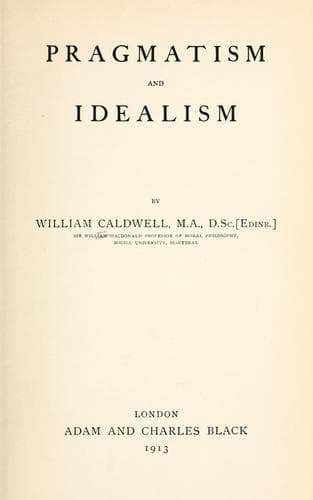
By way of a few quotations illustrative of the fundamental contentions
of the pragmatists, we may select the following: “Ideas become true
just in so far as they help us to get into satisfactory relation with
other parts of our experience, to summarise them and get about among
them by conceptional short-cuts instead of following the interminable
succession of particular phenomena. Any idea upon which we can ride, so
to speak; any idea that will carry us prosperously from any one part
of our experience to any other part, linking things satisfactorily,
working securely, simplifying, saving labour--is true for just so much,
true in so far forth, true instrumentally.”[29] “The true is the name
of whatever proves itself to be good in the way of belief, and good for
definite and assignable reasons.”[30] From Professor Dewey: “Thinking
is a kind of activity which we perform at specific need, just as at
other times we engage in other sorts of activity, as converse with a
friend, draw a plan for a house, take a walk, eat a dinner, purchase
a suit of clothes, etc. etc. The measure of its success, the standard
of its validity is precisely the degree in which thinking disposes of
the difficulty and allows us to proceed with the more direct modes
of experiencing, that are henceforth possessed of more assured and
deepened value.”[31] From Dr. Schiller’s book, _Studies in Humanism_:
“Pragmatism is the doctrine that when an assertion claims truth, its
consequences are always used to test its claims; that (2) the truth
of an assertion depends on its application; that (3) the meaning
of a rule lies in its application; that (4) all meaning depends on
purpose; that (5) all mental life is purposive. It [Pragmatism] must
constitute itself into (6) a systematic protest against all ignoring
of the purposiveness of actual knowing, alike whether it is abstracted
from for the sake of the imaginary, pure, or absolute reason of the
rationalists, or eliminated for the sake of an equally imaginary or
pure mechanism of the naturalists. So conceived, we may describe it as
(7) a conscious application to logic of a teleological psychology which
implies ultimately a voluntaristic metaphysics.”
Public-domain text, read in full here on John Shaqi.
Reviews
Reviews
No reviews yet
Be the first to share your thoughts on this work.
Join the Discussion
Join the discussion
Sign in to leave a comment or review.
Sign InorCreate an account