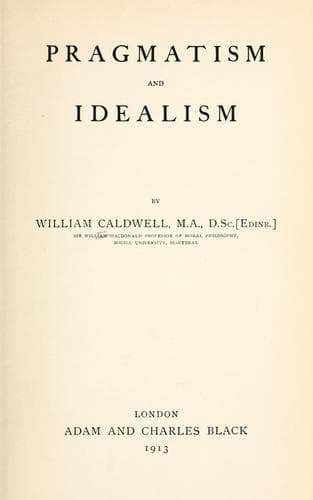
Pragmatism, as the theory is generally understood, rests in the main
upon the work of three men, Professors James and Dewey of America,
and Dr. Schiller of Oxford. The fact, along doubtless with other
things, that these men have ere now been spoken of as occupying a
right, a left, and a centre in the new movement, is presumably an
indication that it has already received its highest theoretical
expression--presumably in the California pamphlet of Professor James,
or in the famous _Popular Science Monthly_ article of Peirce, canonized
as the patron saint of the movement by James.
Whether this be so or not, it has been in the main the work of James to
set forth the meaning of Pragmatism as a philosophy of everyday life,
as the theory of the attitude of man as man to the world in which he
finds himself. Dr. Schiller, again, it is claimed, has done much to set
forth Pragmatism to the world as an essentially humanistic philosophy,
recognizing and providing for the rights of faith and of feeling in
determining our beliefs and our theories about things. This philosophy
has “much in common with what in other quarters is called Personalism.”
It cannot, however, be differentiated so sharply as Dr. Schiller
apparently would have us believe from the many manifestations of this
philosophy that abound in modern times, from Fichte, and from Lotze,
down to men who are still living--Eucken and others. The ingenious
Professor Dewey, moreover, is the champion of the scientific, or the
empirical, or the “instrumental” method in philosophy, and has worked
hard and successfully at the reform which he thinks must take place in
logical and philosophical conceptions when interpreted as simply tools
or devices for the economy of our thought.
When, in pragmatist fashion, we seek to judge of Pragmatism by this
last-mentioned matter of its results, by the things it has enabled its
advocates to accomplish, we find that we may, to begin with, speak in
the following terms of the work of Professor James. He has certainly
indicated how the pragmatist method may be applied to the solution of
some of the ordinary difficulties of reflective thought; about, for
example, the nature of matter or the nature of the soul, or about the
old opposition between the “one” and the “many,” about such concepts
as “thing,” “kinds,” “time,” “space,” the “fancied,” the “real,” and
so on. In all such cases an answer, he holds, is obtained by putting,
say, the initial difficulty in the following form: “What practical
difference can it make now that the world should be run by matter or by
spirit?”
Public-domain text, read in full here on John Shaqi.
Reviews
Reviews
No reviews yet
Be the first to share your thoughts on this work.
Join the Discussion
Join the discussion
Sign in to leave a comment or review.
Sign InorCreate an account