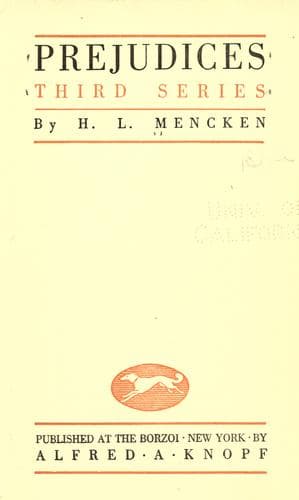
Prejudices, third seriesMencken, H. L. (Henry Louis)
History
Prejudices, third series
Mencken, H. L. (Henry Louis)
American essays -- 20th century; American literature -- History and criticism; Literature -- History and criticism
If the test of the personal culture of a man be the degree of his
freedom from the banal ideas and childish emotions which move the
great masses of men, then Havelock Ellis is undoubtedly the most
civilized Englishman of his generation. He is a man of the soundest
and widest learning, but it is not his positive learning that gives
him distinction; it is his profound and implacable skepticism, his
penetrating eye for the transient, the disingenuous, and the shoddy.
So unconditioned a skepticism, it must be plain, is not an English
habit. The average Englishman of science, though he may challenge the
Continentals within his speciality, is only too apt to sink to the
level of a politician, a green grocer, or a suburban clergyman outside
it. The examples of Wallace, Crookes, and Lodge are anything but
isolated. Scratch an English naturalist and you are likely to discover
a spiritualist; take an English metaphysician to where the band is
playing, and if he begins to snuffle patriotically you need not be
surprised. The late war uncovered this weakness in a wholesale manner.
The English _Gelehrten_, as a class, not only stood by their country;
they also stood by the Hon. David Lloyd-George, the _Daily Mail_, and
the mob in Trafalgar Square. Unluckily, the asinine manifestations
ensuing—for instance, the “proofs” of the eminent Oxford philologist
that the Germans had never contributed anything to philology—are
not to be described with good grace by an American, for they were
far surpassed on this side of the water. England at least had Ellis,
with Bertrand Russell, Wilfrid Scawen Blunt, and a few others in the
background. We had, on that plane, no one.
Public-domain text, read in full here on John Shaqi.
Reviews
Reviews
No reviews yet
Be the first to share your thoughts on this work.
Elsewhere in the archive
Join the Discussion
Join the discussion
Sign in to leave a comment or review.
Sign InorCreate an account