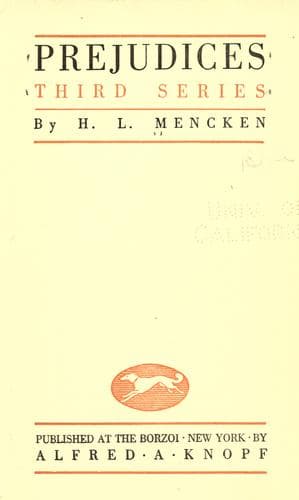
Prejudices, third seriesMencken, H. L. (Henry Louis)
History
Prejudices, third series
Mencken, H. L. (Henry Louis)
American essays -- 20th century; American literature -- History and criticism; Literature -- History and criticism
Is it any wonder that the poor birch-man, facing this labor that would
have staggered Sisyphus Æolusohn, seeks refuge from its essential
impossibility in a Chinese maze of empty technic? The ghost of
Pestalozzi, once bearing a torch and beckoning toward the heights, now
leads down stairways into black and forbidding dungeons. Especially in
America, where all that is bombastic and mystical is most esteemed,
the art of pedagogics becomes a sort of puerile magic, a thing of
preposterous secrets, a grotesque compound of false premises and
illogical conclusions. Every year sees a craze for some new solution of
the teaching enigma, at once simple and infallible—manual training,
playground work, song and doggerel lessons, the Montessori method,
the Gary system—an endless series of flamboyant arcanums. The
worst extravagances of _privat dozent_ experimental psychology are
gravely seized upon; the uplift pours in its ineffable principles and
discoveries; mathematical formulæ are worked out for every emergency;
there is no sure cure so idiotic that some superintendent of schools
will not swallow it.
A couple of days spent examining the literature of the New Thought in
pedagogy are enough to make the judicious weep. Its aim seems to be
to reduce the whole teaching process to a sort of automatic reaction,
to discover some master formula that will not only take the place of
competence and resourcefulness in the teacher but that will also create
an artificial receptivity in the child. The merciless application of
this formula (which changes every four days) now seems to be the chief
end and aim of pedagogy. Teaching becomes a thing in itself, separable
from and superior to the thing taught. Its mastery is a special
business, a transcendental art and mystery, to be acquired in the
laboratory. A teacher well grounded in this mystery, and hence privy
to every detail of the new technic (which changes, of course, with the
formula), can teach anything to any child, just as a sound dentist can
pull any tooth out of any jaw.
All this, I need not point out, is in sharp contrast to the old
theory of teaching. By that theory mere technic was simplified and
subordinated. All that it demanded of the teacher told off to teach,
say, geography, was that he master the facts in the geography book and
provide himself with a stout rattan. Thus equipped, he was ready for a
test of his natural pedagogical genius. First he exposed the facts in
the book, then he gilded them with whatever appearance of interest and
importance he could conjure up, and then he tested the extent of their
transference to the minds of his pupils. Those pupils who had ingested
them got apples; those who had failed got fanned with the rattan.
Followed the second round, and the same test again, with a second
noting of results. And then the third, and fourth, and the fifth, and
so on until the last and least pupil had been stuffed to his subnormal
and perhaps moronic brim.
Public-domain text, read in full here on John Shaqi.
Reviews
Reviews
No reviews yet
Be the first to share your thoughts on this work.
Elsewhere in the archive
Join the Discussion
Join the discussion
Sign in to leave a comment or review.
Sign InorCreate an account