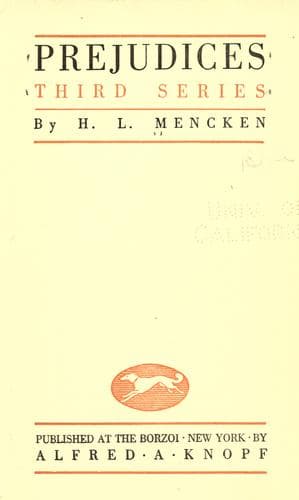
Prejudices, third seriesMencken, H. L. (Henry Louis)
History
Prejudices, third series
Mencken, H. L. (Henry Louis)
American essays -- 20th century; American literature -- History and criticism; Literature -- History and criticism
I was myself grounded in the underlying delusions of what is called
knowledge by this austere process, and despite the eloquence of those
who support newer ideas, I lean heavily in favor of it, and regret to
hear that it is no more. It was crude, it was rough, and it was often
not a little cruel, but it at least had two capital advantages over all
the systems that have succeeded it. In the first place, its machinery
was simple; even the stupidest child could understand it; it hooked
up cause and effect with the utmost clarity. And in the second place,
it tested the teacher as and how he ought to be tested—that is, for
his actual capacity to teach, not for his mere technical virtuosity.
There was, in fact, no technic for him to master, and hence none for
him to hide behind. He could not conceal a hopeless inability to impart
knowledge beneath a correct professional method.
That ability to impart knowledge, it seems to me, has very little to
do with technical method. It may operate at full function without
any technical method at all, and contrariwise, the most elaborate of
technical methods, whether out of Switzerland, Italy or Gary, Ind.,
cannot make it operate when it is not actually present. And what does
it consist of? It consists, first, of a natural talent for dealing
with children, for getting into their minds, for putting things in a
way that they can comprehend. And it consists, secondly, of a deep
belief in the interest and importance of the thing taught, a concern
about it amounting to a sort of passion. A man who knows a subject
thoroughly, a man so soaked in it that he eats it, sleeps it and dreams
it—this man can always teach it with success, no matter how little
he knows of technical pedagogy. That is because there is enthusiasm
in him, and because enthusiasm is almost as contagious as fear or the
barber’s itch. An enthusiast is willing to go to any trouble to impart
the glad news bubbling within him. He thinks that it is important and
valuable for to know; given the slightest glow of interest in a pupil
to start with, he will fan that glow to a flame. No hollow formalism
cripples him and slows him down. He drags his best pupils along as fast
as they can go, and he is so full of the thing that he never tires of
expounding its elements to the dullest.
Public-domain text, read in full here on John Shaqi.
Reviews
Reviews
No reviews yet
Be the first to share your thoughts on this work.
Elsewhere in the archive
Join the Discussion
Join the discussion
Sign in to leave a comment or review.
Sign InorCreate an account