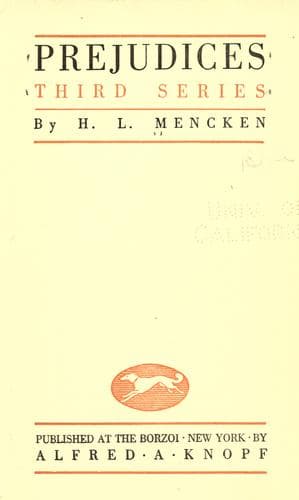
Prejudices, third seriesMencken, H. L. (Henry Louis)
History
Prejudices, third series
Mencken, H. L. (Henry Louis)
American essays -- 20th century; American literature -- History and criticism; Literature -- History and criticism
This passion, so unordered and yet so potent, explains the capacity
for teaching that one frequently observes in scientific men of high
attainments in their specialties—for example, Huxley, Ostwald, Karl
Ludwig, Virchow, Billroth, Jowett, William G. Sumner, Halsted and
Osier—men who knew nothing whatever about the so-called science of
pedagogy, and would have derided its alleged principles if they had
heard them stated. It explains, too, the failure of the general run of
high-school and college teachers—men who are undoubtedly competent,
by the professional standards of pedagogy, but who nevertheless
contrive only to make intolerable bores of the things they presume
to teach. No intelligent student ever learns much from the average
drover of undergraduates; what he actually carries away has come out
of his textbooks, or is the fruit of his own reading and inquiry. But
when he passes to the graduate school, and comes among men who really
understand the subjects they teach, and, what is more, who really love
them, his store of knowledge increases rapidly, and in a very short
while, if he has any intelligence at all, he learns to think in terms
of the thing he is studying.
So far, so good. But an objection still remains, the which may be
couched in the following terms: that in the average college or high
school, and especially in the elementary school, most of the subjects
taught are so bald and uninspiring that it is difficult to imagine
them arousing the passion I have been describing—in brief, that only
an ass could be enthusiastic about them. In witness, think of the
four elementals: reading, penmanship, arithmetic and spelling. This
objection, at first blush, seems salient and dismaying, but only a
brief inspection is needed to show that it is really of very small
validity. It is made up of a false assumption and a false inference.
The false inference is that there is any sound reason for prohibiting
teaching by asses, if only the asses know how to do it, and do it
well. The false assumption is that there are no asses in our schools
and colleges to-day. The facts stand in almost complete antithesis to
these notions. The truth is that the average schoolmaster, on all the
lower levels, is and always must be essentially an ass, for how can one
imagine an intelligent man engaging in so puerile an avocation? And,
the truth is that it is precisely his inherent asininity, and not his
technical equipment as a pedagogue, that is responsible for whatever
modest success he now shows.
Public-domain text, read in full here on John Shaqi.
Reviews
Reviews
No reviews yet
Be the first to share your thoughts on this work.
Elsewhere in the archive
Join the Discussion
Join the discussion
Sign in to leave a comment or review.
Sign InorCreate an account