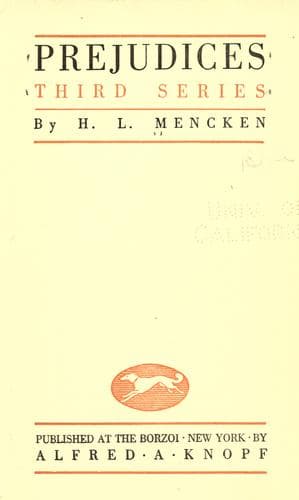
Prejudices, third seriesMencken, H. L. (Henry Louis)
History
Prejudices, third series
Mencken, H. L. (Henry Louis)
American essays -- 20th century; American literature -- History and criticism; Literature -- History and criticism
But this would mean exposing the children of the Republic to contact
with monomaniacs, half-wits, defectives? Well, what of it? The vast
majority of them are already exposed to contact with half-wits in their
own homes; they are taught the word of God by half-wits on Sundays;
they will grow up into Knights of Pythias, Odd Fellows, Red Men and
other such half-wits in the days to come. Moreover, as I have hinted,
they are already face to face with half-wits in the actual schools,
at least in three cases out of four. The problem before us is not
to dispose of this fact, but to utilize it. We cannot hope to fill
the schools with persons of high intelligence, for persons of high
intelligence simply refuse to spend their lives teaching such banal
things as spelling and arithmetic. Among the teachers male we may
safely assume that 95 per cent. are of low mentality, else they would
depart for more appetizing pastures. And even among the teachers female
the best are inevitably weeded out by marriage, and only the worst
(with a few romantic exceptions) survive. The task before us, as I
say, is not to make a vain denial of this cerebral inferiority of the
pedagogue, nor to try to combat and disguise it by concocting a mass of
technical hocus-pocus, but to search out and put to use the value lying
concealed in it. For even stupidity, it must be plain, has its uses in
the world, and some of them are uses that intelligence cannot meet. One
would not tell off a Galileo or a Pasteur to drive an ash-cart or an
Ignatius Loyola to be a stockbroker, or a Brahms to lead the orchestra
in a Broadway cabaret. By the same token, one would not ask a Herbert
Spencer or a Duns Scotus to instruct sucklings. Such men would not only
be wasted at the job; they would also be incompetent. The business
of dealing with children, in fact, demands a certain childishness of
mind. The best teacher, until one comes to adult pupils, is not the one
who knows most, but the one who is most capable of reducing knowledge
to that simple compound of the obvious and the wonderful which slips
easiest into the infantile comprehension. A man of high intelligence,
perhaps, may accomplish the thing by a conscious intellectual feat.
But it is vastly easier to the man (or woman) whose habits of mind are
naturally on the plane of a child’s. The best teacher of children, in
brief, is one who is essentially child-like.
Public-domain text, read in full here on John Shaqi.
Reviews
Reviews
No reviews yet
Be the first to share your thoughts on this work.
Elsewhere in the archive
Join the Discussion
Join the discussion
Sign in to leave a comment or review.
Sign InorCreate an account