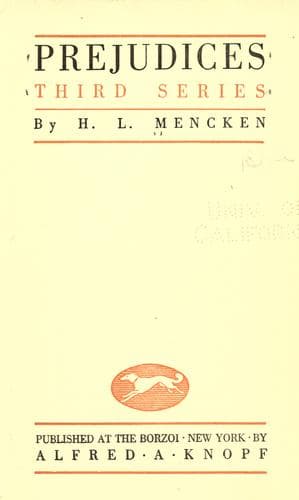
Prejudices, third seriesMencken, H. L. (Henry Louis)
History
Prejudices, third series
Mencken, H. L. (Henry Louis)
American essays -- 20th century; American literature -- History and criticism; Literature -- History and criticism
I go so far with this notion that I view the movement to introduce
female bachelors of arts into the primary schools with the utmost
alarm. A knowledge of Bergsonism, the Greek aorist, sex hygiene and
the dramas of Percy MacKaye is not only no help to the teaching of
spelling, it is a positive handicap to the teaching of spelling,
for it corrupts and blows up that naïve belief in the glory and
portentousness of spelling which is at the bottom of all successful
teaching of it. If I had my way, indeed, I should expose all candidates
for berths in the infant grades to the Binet-Simon test, and reject all
those who revealed the mentality of more than fifteen years. Plenty
would still pass. Moreover, they would be secure against contamination
by the new technic of pedagogy. Its vast wave of pseudo-psychology
would curl and break against the hard barrier of their innocent
and passionate intellects—as it probably does, in fact, even now.
They would know nothing of cognition, perception, attention, the
subconscious and all the other half-fabulous fowl of the pedagogic
aviary. But they would see in reading, writing and arithmetic the gaudy
charms of profound and esoteric knowledge, and they would teach these
ancient branches, now so abominably in decay, with passionate gusto,
and irresistible effectiveness, and a gigantic success.
II
Two great follies corrupt the present pedagogy, once it gets beyond
the elementals. One is the folly of overestimating the receptivity
of the pupil; the other is the folly of overestimating the possible
efficiency of the teacher. Both rest upon that tendency to put too
high a value upon mere schooling which characterizes democratic and
upstart societies—a tendency born of the theory that a young man
who has been “educated,” who has “gone through college,” is in some
subtle way more capable of making money than one who hasn’t. The
nature of the schooling on tap in colleges is but defectively grasped
by the adherents of the theory. They view it, I believe, as a sort of
extension of the schooling offered in elementary schools—that is, as
an indefinite multiplication of training in such obviously valuable and
necessary arts as reading, writing and arithmetic. It is, of course,
nothing of the sort. If the pupil, as he climbs the educational ladder,
is fortunate enough to come into contact with a few Huxleys or Ludwigs,
he may acquire a great deal of extremely sound knowledge, and even
learn how to think for himself. But in the great majority of cases he
is debarred by two things: the limitations of his congenital capacity
and the limitations of the teachers he actually encounters. The latter
is usually even more brilliantly patent than the former. Very few
professional teachers, it seems to me, really know anything worth
knowing, even about the subjects they essay to teach. If you doubt it,
simply examine their contributions to existing knowledge. Several years
Public-domain text, read in full here on John Shaqi.
Reviews
Reviews
No reviews yet
Be the first to share your thoughts on this work.
Elsewhere in the archive
Join the Discussion
Join the discussion
Sign in to leave a comment or review.
Sign InorCreate an account