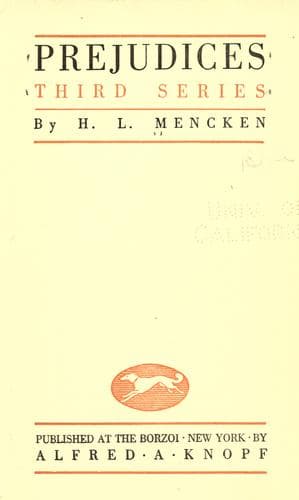
Prejudices, third seriesMencken, H. L. (Henry Louis)
History
Prejudices, third series
Mencken, H. L. (Henry Louis)
American essays -- 20th century; American literature -- History and criticism; Literature -- History and criticism
ago, while engaged upon my book, “The American Language,” I had a good
chance to test the matter in one typical department, that of philology.
I found a truly appalling condition of affairs. I found that in the
whole United States there were not two dozen teachers of English
philology—in which class I also include the innumerable teachers of
plain grammar—who had ever written ten lines upon the subject worth
reading. It was not that they were indolent or illiterate: in truth,
they turned out to be enormously diligent. But as I plowed through
pyramid after pyramid of their doctrines and speculations, day after
day and week after week, I discovered little save a vast laboring of
the obvious, with now and then a bold flight into the nonsensical. A
few genuinely original philologians revealed themselves—pedagogues
capable of observing accurately and reasoning clearly. The rest simply
wasted time and paper. Whole sections of the field were unexplored, and
some of them appeared to be even unsuspected. The entire life-work of
many an industrious professor, boiled down, scarcely made a footnote in
my book, itself a very modest work.
This tendency to treat the superior pedagogue too seriously—to view
him as, _ipso facto_, a learned man, and one thus capable of conveying
learning to others—is supported by the circumstance that he so views
himself, and is, in fact, very pretentious and even bombastic. Nearly
all discussions of the educational problem, at least in the United
States, are carried on by schoolmasters or ex-schoolmasters—for
example, college presidents, deans, and other such magnificoes—and so
they assume it to be axiomatic that such fellows are genuine bearers
of the enlightenment, and hence capable of transmitting it to others.
This is true sometimes, as I have said, but certainly not usually.
The average high-school or college pedagogue is not one who has been
selected because of his uncommon knowledge; he is simply one who has
been stuffed with formal ideas and taught to do a few conventional
intellectual tricks. Contact with him, far from being inspiring to
any youth of alert mentality, is really quite depressing; his point
of view is commonplace and timorous; his best thought is no better
than that of any other fourth-rate professional man, say a dentist or
an advertisement writer. Thus it is idle to talk of him as if he were
a Socrates, an Aristotle, or even a Leschetizky. He is actually much
more nearly related to a barber or a lieutenant of marines. A worthy
man, industrious and respectable—but don’t expect too much of him. To
ask him to struggle out of his puddle of safe platitudes and plunge
into the whirlpool of surmise and speculation that carries on the
fragile shallop of human progress—to do this is as absurd as to ask a
neighborhood doctor to undertake major surgery.
Public-domain text, read in full here on John Shaqi.
Reviews
Reviews
No reviews yet
Be the first to share your thoughts on this work.
Elsewhere in the archive
Join the Discussion
Join the discussion
Sign in to leave a comment or review.
Sign InorCreate an account