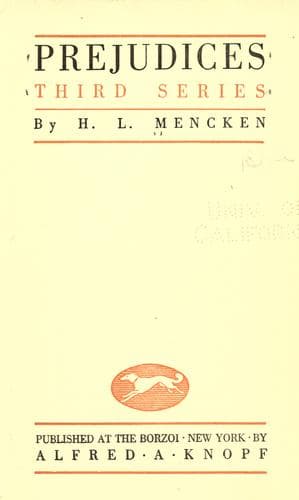
Prejudices, third seriesMencken, H. L. (Henry Louis)
History
Prejudices, third series
Mencken, H. L. (Henry Louis)
American essays -- 20th century; American literature -- History and criticism; Literature -- History and criticism
All government, in its essence, is a conspiracy against the superior
man: its one permanent object is to police him and cripple him. If
it be aristocratic in organization, then it seeks to protect the man
who is superior only in law against the man who is superior in fact;
if it be democratic, then it seeks to protect the man who is inferior
in every way against both. Thus one of its primary functions is to
regiment men by force, to make them as much alike as possible and
as dependent upon one another as possible, to search out and combat
originality among them. All it can see in an original idea is potential
change, and hence an invasion of its prerogatives. The most dangerous
man, to any government, is the man who is able to think things out for
himself, without regard to the prevailing superstitions and taboos.
Almost inevitably he comes to the conclusion that the government he
lives under is dishonest, insane and intolerable, and so, if he
is romantic, he tries to change it. And even if he is not romantic
personally he is very apt to spread discontent among those who are.
Ludwig van Beethoven was certainly no politician. Nor was he a patriot.
Nor had he any democratic illusions in him: he held the Viennese in
even more contempt than he held the Hapsburgs. Nevertheless, I am
convinced that the sharp criticism of the Hapsburg government that
he used to loose in the cafés of Vienna had its effects—that some
of his ideas of 1818, after a century of germination, got themselves
translated into acts in 1918. Beethoven, like all other first-rate
men, greatly disliked the government he lived under. I add the names
of Goethe, Heine, Wagner and Nietzsche, to keep among Germans. That of
Bismarck might follow: he admired the Hohenzollern idea, as Carlyle
did, not the German people or the German administration. In his
“Errinerungen,” whenever he discusses the government that he was a part
of, he has difficulty keeping his contempt within the bounds of decorum.
Public-domain text, read in full here on John Shaqi.
Reviews
Reviews
No reviews yet
Be the first to share your thoughts on this work.
Elsewhere in the archive
Join the Discussion
Join the discussion
Sign in to leave a comment or review.
Sign InorCreate an account