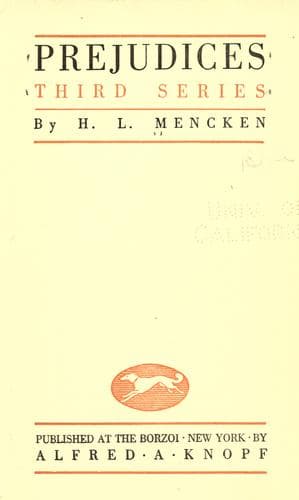
Prejudices, third seriesMencken, H. L. (Henry Louis)
History
Prejudices, third series
Mencken, H. L. (Henry Louis)
American essays -- 20th century; American literature -- History and criticism; Literature -- History and criticism
Nine times out of ten, it seems to me, the man who proposes a change
in the government he lives under, no matter how defective it may be,
is romantic to the verge of sentimentality. There is seldom, if ever,
any evidence that the kind of government he is unlawfully inclined
to would be any better than the government he proposes to supplant.
Political revolutions, in truth, do not often accomplish anything of
genuine value; their one undoubted effect is simply to throw out one
gang of thieves and put in another. After a revolution, of course,
the successful revolutionists always try to convince doubters that
they have achieved great things, and usually they hang any man who
denies it. But that surely doesn’t prove their case. In Russia, for
many years, the plain people were taught that getting rid of the Czar
would make them all rich and happy, but now that they have got rid of
him they are poorer and unhappier than ever before. The Germans, with
the Kaiser in exile, have discovered that a shoemaker turned statesman
is ten times as bad as a Hohenzollern. The Alsatians, having become
Frenchmen again after 48 years anxious wait, have responded to the boon
by becoming extravagant Germanomaniacs. The Tyrolese, though they hated
the Austrians, now hate the Italians enormously more. The Irish, having
rid themselves of the English after 700 years of struggle, instantly
discovered that government by Englishmen, compared to government by
Irishmen, was almost paradisiacal. Even the American colonies gained
little by their revolt in 1776. For twenty-five years after the
Revolution they were in far worse condition as free states than they
would have been as colonies. Their government was more expensive,
more inefficient, more dishonest, and more tyrannical. It was only
the gradual material progress of the country that saved them from
starvation and collapse, and that material progress was due, not to the
virtues of their new government, but to the lavishness of nature. Under
the British hoof they would have got on just as well, and probably a
great deal better.
The ideal government of all reflective men, from Aristotle to Herbert
Spencer, is one which lets the individual alone—one which barely
escapes being no government at all. This ideal, I believe, will be
realized in the world twenty or thirty centuries after I have passed
from these scenes and taken up my home in Hell.
2
_On Minorities_
Public-domain text, read in full here on John Shaqi.
Reviews
Reviews
No reviews yet
Be the first to share your thoughts on this work.
Elsewhere in the archive
Join the Discussion
Join the discussion
Sign in to leave a comment or review.
Sign InorCreate an account