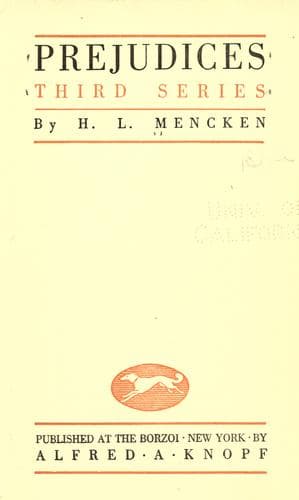
Prejudices, third seriesMencken, H. L. (Henry Louis)
History
Prejudices, third series
Mencken, H. L. (Henry Louis)
American essays -- 20th century; American literature -- History and criticism; Literature -- History and criticism
The older I grow the more I distrust the familiar doctrine that age
brings wisdom. It is my honest belief that I am no wiser to-day
than I was five or ten years ago; in fact, I often suspect that I
am appreciable _less_ wise. Women can prevail over me to-day by
devices that would have made me hoof them out of my studio when I was
thirty-five. I am also an easier mark for male swindlers than I used
to be; at fifty I’ll probably be joining clubs and buying Mexican
mine stock. The truth is that every man goes up-hill in sagacity
to a certain point, and then begins sliding down again. Nearly all
the old fellows that I know are more or less balmy. Theoretically,
they should be much wiser than younger men, if only because of their
greater experience, but actually they seem to take on folly faster than
they take on wisdom. A man of thirty-five or thirty-eight is almost
woman-proof. For a woman to marry him is a herculean feat. But by the
time he is fifty he is quite as easy as a Yale sophomore. On other
planes the same decay of the intelligence is visible. Certainly it
would be difficult to imagine any committee of relatively young men, of
thirty or thirty-five, showing the unbroken childishness, ignorance and
lack of humor of the Supreme Court of the United States. The average
age of the learned justices must be well beyond sixty, and all of
them are supposed to be of finished and mellowed sagacity. Yet their
knowledge of the most ordinary principles of justice often turns out
to be extremely meager, and when they spread themselves grandly upon
a great case their reasoning powers are usually found to be precisely
equal to those of a respectable Pullman conductor.
3
_Duty_
Some of the loosest thinking in ethics has duty for its theme.
Practically all writers on the subject agree that the individual
owes certain unescapable duties to the race—for example, the duty
of engaging in productive labor, and that of marrying and begetting
offspring. In support of this position it is almost always argued that
if _all_ men neglected such duties the race would perish. The logic is
hollow enough to be worthy of the college professors who are guilty
of it. It simply confuses the conventionality, the pusillanimity, the
lack of imagination of the majority of men with the duty of _all_ men.
There is not the slightest ground for assuming, even as a matter of
mere argumentation, that _all_ men will ever neglect these alleged
duties. There will always remain a safe majority that is willing to
do whatever is ordained—that accepts docilely the government it is
born under, obeys its laws, and supports its theory. But that majority
does not comprise the men who render the highest and most intelligent
services to the race; it comprises those who render nothing save their
obedience.
Public-domain text, read in full here on John Shaqi.
Reviews
Reviews
No reviews yet
Be the first to share your thoughts on this work.
Elsewhere in the archive
Join the Discussion
Join the discussion
Sign in to leave a comment or review.
Sign InorCreate an account