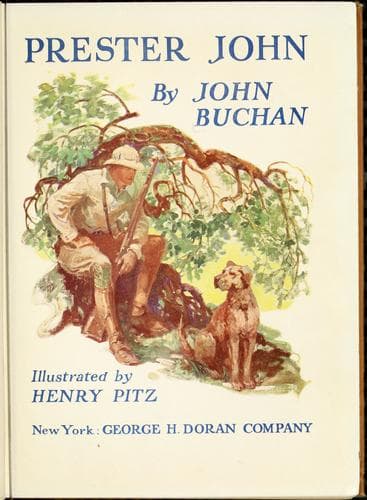
Adventure stories; Clergy -- Fiction; Scots -- South Africa -- Fiction; South Africa -- Fiction; Zulu (African people) -- Fiction
“So he is dead,” he said at last, half-whispering to himself. “Well, he
was a king, and died like a king. Our job now is simple, for there is
none of his breed left in Africa.”
Then I told him of the treasure.
“It belongs to you, Davie,” he said, “and we must see that you get it.
This is going to be a long war, but if we survive to the end you will
be a rich man.”
“But in the meantime?” I asked. “Supposing other Kaffirs hear of it,
and come back and make a bridge over the gorge? They may be doing it
now.”
“I’ll put a guard on it,” he said, jumping up briskly. “It’s maybe not
a soldier’s job, but you’ve saved this country, Davie, and I’m going to
make sure that you have your reward.”
After that I went with Arcoll to Inanda’s Kraal. I am not going to tell
the story of that performance, for it occupies no less than two
chapters in Mr Upton’s book. He makes one or two blunders, for he
spells my name with an “o,” and he says we walked out of the camp on
our perilous mission “with faces white and set as a Crusader’s.” That
is certainly not true, for in the first place nobody saw us go who
could judge how we looked, and in the second place we were both smoking
and feeling quite cheerful. At home they made a great fuss about it,
and started a newspaper cry about the Victoria Cross, but the danger
was not so terrible after all, and in any case it was nothing to what I
had been through in the past week.
I take credit to myself for suggesting the idea. By this time we had
the army in the kraal at our mercy. Laputa not having returned, they
had no plans. It had been the original intention to start for the
Olifants on the following day, so there was a scanty supply of food.
Besides, there were the makings of a pretty quarrel between Umbooni and
some of the north-country chiefs, and I verily believe that if we had
held them tight there for a week they would have destroyed each other
in faction fights. In any case, in a little they would have grown
desperate and tried to rush the approaches on the north and south. Then
we must either have used the guns on them, which would have meant a
great slaughter, or let them go to do mischief elsewhere. Arcoll was a
merciful man who had no love for butchery; besides, he was a statesman
with an eye to the future of the country after the war. But it was his
duty to isolate Laputa’s army, and at all costs, it must be prevented
from joining any of the concentrations in the south.
Then I proposed to him to do as Rhodes did in the Matoppos, and go and
talk to them. By this time, I argued, the influence of Laputa must have
sunk, and the fervour of the purification be half-forgotten. The army
had little food and no leader. The rank and file had never been
fanatical, and the chiefs and indunas must now be inclined to sober
reflections. But once blood was shed the lust of blood would possess
them. Our only chance was to strike when their minds were perplexed and
undecided.
Public-domain text, read in full here on John Shaqi.
Reviews
Reviews
No reviews yet
Be the first to share your thoughts on this work.
Elsewhere in the archive
Join the Discussion
Join the discussion
Sign in to leave a comment or review.
Sign InorCreate an account