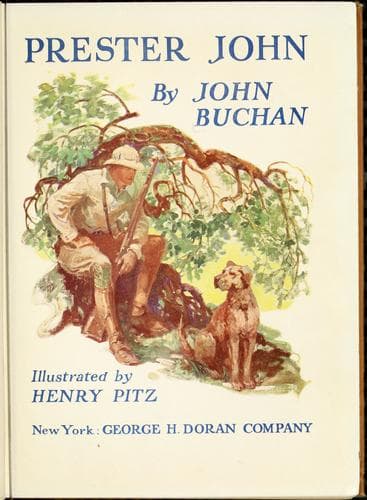
Adventure stories; Clergy -- Fiction; Scots -- South Africa -- Fiction; South Africa -- Fiction; Zulu (African people) -- Fiction
Arcoll did all the arranging. He had a message sent to the chiefs
inviting them to an indaba, and presently word was brought back that an
indaba was called for the next day at noon. That same night we heard
that Umbooni and about twenty of his men had managed to evade our ring
of scouts and got clear away to the south. This was all to our
advantage, as it removed from the coming indaba the most irreconcilable
of the chiefs.
That indaba was a queer business. Arcoll and I left our escort at the
foot of a ravine, and entered the kraal by the same road as I had left
it. It was a very bright, hot winter’s day, and try as I might, I could
not bring myself to think of any danger. I believed that in this way
most temerarious deeds are done; the doer has become insensible to
danger, and his imagination is clouded with some engrossing purpose.
The first sentries received us gloomily enough, and closed behind us as
they had done when Machudi’s men haled me thither. Then the job became
eerie, for we had to walk across a green flat with thousands of eyes
watching us. By-and-by we came to the merula tree opposite the kyas,
and there we found a ring of chiefs, sitting with cocked rifles on
their knees.
We were armed with pistols, and the first thing Arcoll did was to hand
them to one of the chiefs. “We come in peace,” he said. “We give you
our lives.”
Then the indaba began, Arcoll leading off. It was a fine speech he
made, one of the finest I have ever listened to. He asked them what
their grievances were; he told them how mighty was the power of the
white man; he promised that what was unjust should be remedied, if only
they would speak honestly and peacefully; he harped on their old
legends and songs, claiming for the king of England the right of their
old monarchs. It was a fine speech, and yet I saw that it did not
convince them. They listened moodily, if attentively, and at the end
there was a blank silence.
Arcoll turned to me. “For God’s sake, Davie,” he said, “talk to them
about Laputa. It’s our only chance.”
I had never tried speaking before, and though I talked their tongue I
had not Arcoll’s gift of it. But I felt that a great cause was at
stake, and I spoke up as best I could.
I began by saying that Inkulu had been my friend, and that at Umvelos’
before the rising he had tried to save my life. At the mention of the
name I saw eyes brighten. At last the audience was hanging on my words.
I told them of Henriques and his treachery. I told them frankly and
fairly of the doings at Dupree’s Drift. I made no secret of the part I
played. “I was fighting for my life,” I said. “Any man of you who is a
man would have done the like.”
Then I told them of my last ride, and the sight I saw at the foot of
the Rooirand. I drew a picture of Henriques lying dead with a broken
neck, and the Inkulu, wounded to death, creeping into the cave.
Public-domain text, read in full here on John Shaqi.
Reviews
Reviews
No reviews yet
Be the first to share your thoughts on this work.
Elsewhere in the archive
Join the Discussion
Join the discussion
Sign in to leave a comment or review.
Sign InorCreate an account