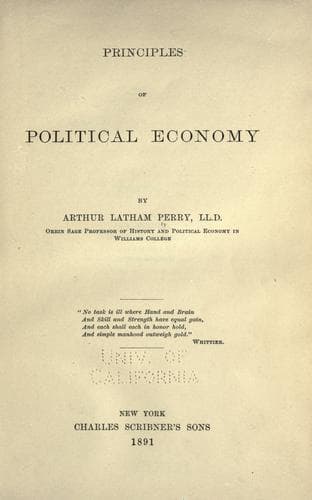
Principles of Political EconomyPerry, Arthur Latham
General
Principles of Political Economy
Perry, Arthur Latham
Economics
Perhaps some one of my readers may suggest, that these are the words
of a Whig-Liberal, and may thus exaggerate the cause of the people as
against the monopolists. Well, then, let us hear the words of a high
Tory-Loyalist, the historian Hume (IV, 335, 350), in relation to the
same monopolies. "_The active reign of Elizabeth had enabled many
persons to distinguish themselves in civil and military employments;
and the Queen, who was not able from her revenue to give them any
rewards proportioned to their services, had made use of an expedient
which had been employed by her predecessors, but which had never been
carried to such an extreme as under her administration. She granted
her servants and courtiers patents for monopolies; and those patents
they sold to others, who were thereby enabled to raise commodities to
what price they pleased, and who put invincible restraints upon all
commerce, industry, and emulation in the arts. It is astonishing to
consider the number and the importance of those commodities which were
thus assigned over to patentees. Currants, salt, iron, powder, cards,
calf-skins, felts, pouldavies, ox-skin-bones, train oil, lists of
cloth, potashes, anise-seeds, vinegar, seacoals, steel, aquavitæ,
brushes, pots, bottles, saltpetre, lead, accidences, oil, calamine
stone, oil of blubber, glasses, paper, starch, tin, sulphur, new
drapery, dried pilchards, transportation of iron ordnance, of beer, of
horn, of leather, importation of Spanish wool, of Irish yarn; these
are but a part of the commodities which had been appropriated to
monopolists. These monopolists were so exorbitant in their demands,
that in some places they raised the price of salt from sixteen pence a
bushel to fourteen or fifteen shillings. Such high profits naturally
begat intruders upon their commerce; and in order to secure themselves
against encroachments, the patentees were armed with high and
arbitrary powers from the Council, by which they were enabled to
oppress the people at pleasure, and to exact money from such as they
thought proper to accuse of interfering with their patent. The
patentees of saltpetre, having the power of entering into every house,
and of committing what havoc they pleased in stables, cellars, or
wherever they expected saltpetre might be gathered, commonly extorted
money from those who desired to free themselves from this damage or
trouble. And while all domestic intercourse was restrained, lest any
scope should remain for industry, almost every species of foreign
commerce was confined to exclusive Companies, who bought and sold at
any price that they themselves thought proper to offer or exact._"
Public-domain text, read in full here on John Shaqi.
Reviews
Reviews
No reviews yet
Be the first to share your thoughts on this work.
Elsewhere in the archive
Join the Discussion
Join the discussion
Sign in to leave a comment or review.
Sign InorCreate an account