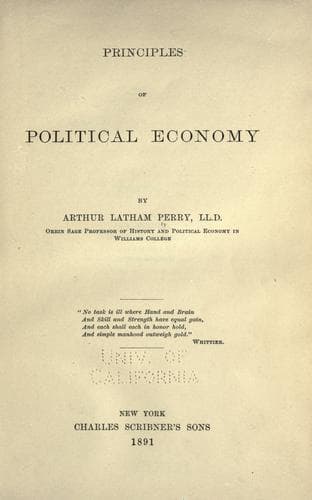
Principles of Political EconomyPerry, Arthur Latham
General
Principles of Political Economy
Perry, Arthur Latham
Economics
"_The Government of England during that age, however different in
other particulars, bore in this respect some resemblance to that of
Turkey at present: the Sovereign possessed every power, except that of
imposing taxes; and in both countries, this limitation, unsupported by
other privileges, appears rather prejudicial to the people. In Turkey,
it obliges the Sultan to permit the extortion of the pashas and
governors of provinces, from whom he afterwards squeezes presents and
takes forfeitures: in England, it engaged the Queen to erect
monopolies, and grant patents for exclusive trade; an invention so
pernicious, that had she gone on during a tract of years at her own
rate, England, the seat of riches, and arts, and commerce, would have
contained at present as little industry as Morocco or the coast of
Barbary._"
But, some one will say, Hume and Macaulay are historians, writing
long after these events took place, and may likely have been too
favorable in their judgment to freedom of trade domestic and foreign.
It is indeed true, that both of them were firmly convinced that
freedom of trade is an inalienable right as well as an unspeakable
blessing to all men everywhere. So, then, let us go back to
contemporaries. Let us hear the eye and ear witnesses of the
grievances complained of in 1601. Robert Cecil was then prime minister
of Queen Elizabeth. He and his father had had more to do in granting
the monopolies than any other persons in the realm except the Queen.
Said he from his place in the Commons on the 25th of November: "_I
say, therefore, there shall be a proclamation general throughout the
realm, to notify Her Majesty's resolution in this behalf. And because
you may eat your meat more savory than you have done, every man shall
have salt as good and cheap as he can buy it or make, freely without
danger of that patent which shall be presently revoked. The same
benefit shall they have which have cold stomachs, both for aqua vitæ
and aqua composita and the like. And they that have weak stomachs, for
their satisfaction, shall have vinegar and alegar, and the like, set
at liberty. Train oil shall go the same way; oil of blubber shall
march in equal rank; brushes and bottles endure the like judgment.
Those that desire to go sprucely in their ruffs, may at less charge
than accustomed obtain their wish; for the patent for starch, which
hath so much been prosecuted, shall now be repealed. The patents for
calf-skins and felts, for leather, for cards, for glass, shall also be
suspended, and left to the law._"
Public-domain text, read in full here on John Shaqi.
Reviews
Reviews
No reviews yet
Be the first to share your thoughts on this work.
Elsewhere in the archive
Join the Discussion
Join the discussion
Sign in to leave a comment or review.
Sign InorCreate an account