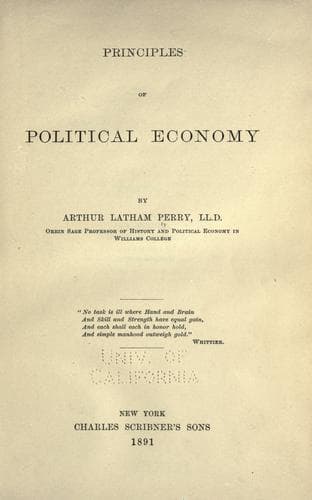
Principles of Political EconomyPerry, Arthur Latham
General
Principles of Political Economy
Perry, Arthur Latham
Economics
Our second instance of Monopolies shall be drawn from the state of
things in the United States in this year of Grace, 1890. The
monopolies of to-day are secured by means of an instrument called a
Tariff, which, later on in these pages, will be fully discussed in its
history, inmost nature, and invariable effects. Here it will suffice
to say, that a tariff is nothing in the world but a combination of
Taxes, which taxes the people of the country, on which the tariff is
imposed, are obliged to pay in one form or another. The only word ever
uttered by a tariff, the only word a tariff from its own nature can
utter, is, _Thou shalt pay_! The ostensible reason for levying these
taxes is the constitutional one of getting money into the national
Treasury,--"_to pay the debts and provide for the common defence and
general welfare of the United States_"; but the real purpose of laying
these tariff-taxes at present is only secondarily and remotely the
ostensible and constitutional one; because, on the authority of
Professor Taussig of Harvard University, there is not a single one of
over 4000 items of taxes in this tariff, that is designed primarily to
get money into the treasury from the pockets of the people, but every
one of them is designed more or less and more rather than less to
raise the price of domestic goods to our own people artificially by
keeping out of the country by means of these taxes on them the foreign
goods, which would otherwise come into a profit. In other words, there
is no purely revenue-tax in our immense tariff at present, but every
item in the enormous list is a so-called and mis-called
"protective"-tax.
Public-domain text, read in full here on John Shaqi.
Reviews
Reviews
No reviews yet
Be the first to share your thoughts on this work.
Elsewhere in the archive
Join the Discussion
Join the discussion
Sign in to leave a comment or review.
Sign InorCreate an account