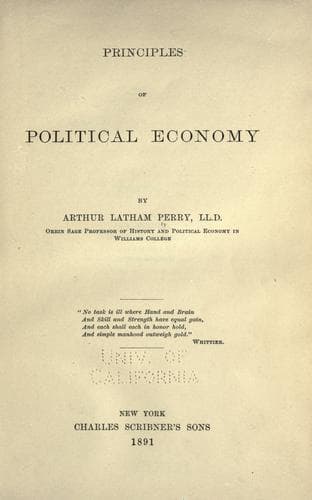
Principles of Political EconomyPerry, Arthur Latham
General
Principles of Political Economy
Perry, Arthur Latham
Economics
Five days later one hundred and forty members of the House were
formally received by Elizabeth in person, the Speaker having been
instructed to convey their thanks to her majesty; and, after the
Speaker's address, he with the rest knelt down, and the Queen gave her
answer as follows: "_Mr. Speaker, you give me thanks, but I doubt me,
I have more cause to thank you all, than you me: for had I not
received a knowledge from you, I might have fallen into the lap of an
error, only for lack of true information. Since I was queen, yet never
did I put my pen to any grant, but that upon pretext and semblance
made unto me that it was both good and beneficial to the subjects in
general, though a private profit to some of my ancient servants who
had deserved well; but the contrary being found by experience, I am
exceeding beholding to such subjects as would move the same at first.
I have ever used to set the last judgment-day before mine eyes, and so
to rule as I shall be judged to answer before a higher judge. To whose
judgment-seat I do appeal, that never thought was cherished in my
heart that tended not to my people's good. And now if my kingly bounty
hath been abused, and my grants turned to the hurt of my people,
contrary to my will and meaning; or if any in authority under me have
neglected or prevented what I have committed to them, I hope God will
not lay their culps and offences to my charge. Though you have had,
and may have, many princes more mighty and wise, sitting in this seat,
yet you never had, or shall have, any that will be more careful and
loving._"[4]
These were the last words of Elizabeth to the Commons of England. She
died in a little more than a year. In a little less than a year before
the death of her successor, the famous Act of Parliament of 1624
declares, that all monopolies, grants, letters patent for the sole
buying, selling, and making of goods and manufactures, shall be
thereafter wholly null and void. Though this Act, and many others, was
violated more or less in the next reign, it effectually secured in the
long run the freedom of industry in England; and in the opinion of
excellent authorities, has done more to excite the spirit of invention
and industry, and to accelerate the progress of commerce in that
country, than any other law on the statute book.
Public-domain text, read in full here on John Shaqi.
Reviews
Reviews
No reviews yet
Be the first to share your thoughts on this work.
Elsewhere in the archive
Join the Discussion
Join the discussion
Sign in to leave a comment or review.
Sign InorCreate an account