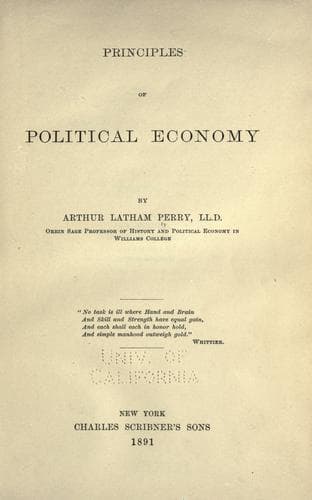
Principles of Political EconomyPerry, Arthur Latham
General
Principles of Political Economy
Perry, Arthur Latham
Economics
A third effect of tariff-monopoly is to prevent the sale abroad of
domestic goods to the same extent and amount as foreign wares are kept
out by these monopoly-taxes. This vital and fundamental result is
almost always overlooked. If a man or a nation refuse to _buy_ of a
proffered customer, they cannot by any possibility _sell_ to him;
because buying and selling are reciprocal and synchronous; because it
takes two to make a bargain; because material commodities, for the
most part, ultimately, exchange against each other; and because the
only motive a foreigner ever has to bring his goods _hither_, is to
take in exchange for them our domestic goods at a profit, and carry
these _hence_. To forbid entrance to foreign goods is to forbid exit
to domestic goods. Monopoly-tariff-taxes, therefore, so far forth,
destroy the market for home products, without creating or tending to
create, any other market for them. Such taxes, accordingly, cause a
dead loss all around,--to the foreign producer who wants to buy our
products with his own, to the home producer who wants to sell his own
products against those, and even to the government also as a
tax-collector, which can get no revenue on foreign goods excluded by
monopoly-taxes.
There is a final and deeper point of view, from which all such
monopolies are wholly condemnable. _They lessen of necessity,--from
their own nature and inexorable operation_,--THE DIVERSITY OF RELATIVE
ADVANTAGE AS BETWEEN EXCHANGERS, on which diversity, as we have now
seen, the whole fact and gain of exchanges depend. Taxes on raw
materials, for example, whether actually paid on them or used to
enhance the price of other corresponding materials as in the
tariff-taxes, increase the costs of all products into which such taxed
materials enter, and so restrict the market of the home-producer by
lessening his relative advantage as compared with the relative
advantage of the foreigner over him. He cannot sell so well, perhaps
cannot sell at all, his cost-enhanced products. Monopoly-taxes on
industrial processes of any kind, on the means of transportation, have
similar effects on the cost of products; and of course, similar
effects in lessening Diversity, in restricting markets, and in
destroying the life of Trade.
Before quitting this subject, it may be well for us briefly to
classify Monopolies.
Public-domain text, read in full here on John Shaqi.
Reviews
Reviews
No reviews yet
Be the first to share your thoughts on this work.
Elsewhere in the archive
Join the Discussion
Join the discussion
Sign in to leave a comment or review.
Sign InorCreate an account