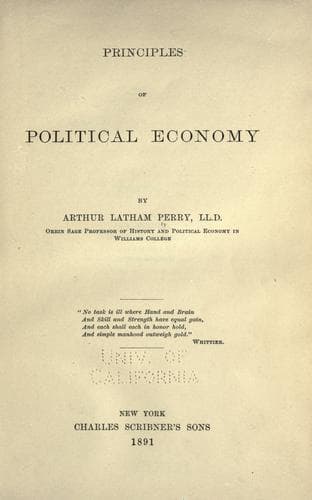
Principles of Political EconomyPerry, Arthur Latham
General
Principles of Political Economy
Perry, Arthur Latham
Economics
(a) Patent Rights. In the great parliamentary Statute of 21 James I,
which declared the exclusive privileges to use any and to sell any
merchandise to be contrary to the ancient and fundamental laws of the
realm, and all grants and dispensations for such monopolies to be of
none effect, two exceptions had been made; the first, in favor of
Patents for fourteen years to the true and first inventors of new
manufactures within the realm; and the second, in favor of the grants
by Act of Parliament to any Company for the enlargement of foreign
Trade, of which the East India Company chartered on the last day of
the last year of the sixteenth century became the most famous and the
longest-lived. Open letters or letters _patent_, as they were called,
giving to inventors exclusive authority to vend for a limited time any
chattel or article of commerce, of which a _model_ could be made
showing the point and application of what was claimed to be _new_; and
Copyrights, which grant an exclusive property also for a limited time
to authors and discoverers of something new and useful, of which a
model cannot be made, or, as it is phrased in the Constitution of the
United States, "_the exclusive right to their respective writings and
discoveries_"; are a part of the results among all English-speaking
peoples of the two exceptions in this famous and beneficent Act of
Parliament.
In the United States a patent lasts for 17 years, and is not reissued
except by a special act of Congress; a copyright lasts for 28 years,
and may be renewed by the author, his widow, or children, for 14 years
longer. In the constitution of the new German Empire of 1871, this
protection of intellectual property (_der Schutz des geistigen
Eigenthums_) is expressly included in the matters which are to be
dealt with by the _Reichstag_ or imperial parliament.
Public-domain text, read in full here on John Shaqi.
Reviews
Reviews
No reviews yet
Be the first to share your thoughts on this work.
Elsewhere in the archive
Join the Discussion
Join the discussion
Sign in to leave a comment or review.
Sign InorCreate an account