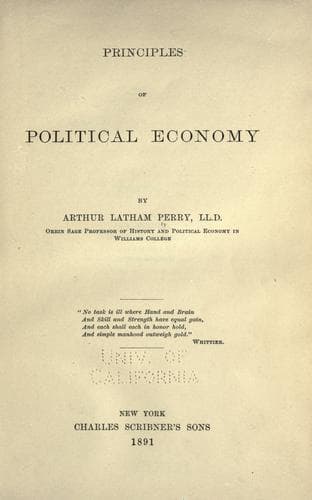
Principles of Political EconomyPerry, Arthur Latham
General
Principles of Political Economy
Perry, Arthur Latham
Economics
The expression, "natural monopoly," is sometimes used of those, who,
under freedom, and using to the utmost their natural gifts and
acquired skill, have distanced all local competitors, and may be said
to control the market in their own interest, furnishing the best goods
at the cheapest rates. This is in no proper sense of the term a
"monopoly." Production has no complaint to make of any such
pre-eminence in excellence and opportunity. It harms nobody and
benefits everybody. Exchange rejoices over every man and woman and
child, who so puts his head and heart and hand into his own peculiar
product as to outstrip all others in that one line in point of ease
and excellence, and so be able to offer a service at once better and
cheaper than any one else can offer it then and there; and when all
men and women and children, so far as they are employed commercially,
come to possess a "natural monopoly" each in his own specialty, then
Exchanges become as profitable and progressive as possible then and
there, because the ever-blessed diversity of relative advantage has
its utmost limit.
4. We come now to consider the natural LIMITS, if any such there be,
to the Production of material commodities. This point has been much
discussed. For example, Dr. Chalmers, a Scotch clergyman of great
intelligence, profoundly moved by the condition of the poor in
Glasgow, published in 1822 an interesting but not over-sound treatise
entitled "Political Economy," in which the proposition is maintained,
that the universal market is strictly limited, and therefore that,
were it not for the unproductive consumption of the rich and
luxurious, and the equally unproductive consumption of national wars,
there would soon be a general glut of material commodities, and
consequently Production would have to cease for the lack of a vent for
its products. Pretty soon we shall be able to detect the enormous
fallacy in this proposition. On the other hand, in 1803, Jean-Baptiste
Say, a very competent French economist, in chapter xv of his
well-known treatise, fully developed this very important proposition,
if true, namely, _that production may go on indefinitely in all
directions without ever a fear of reaching a general glut of
products_.
Public-domain text, read in full here on John Shaqi.
Reviews
Reviews
No reviews yet
Be the first to share your thoughts on this work.
Elsewhere in the archive
Join the Discussion
Join the discussion
Sign in to leave a comment or review.
Sign InorCreate an account