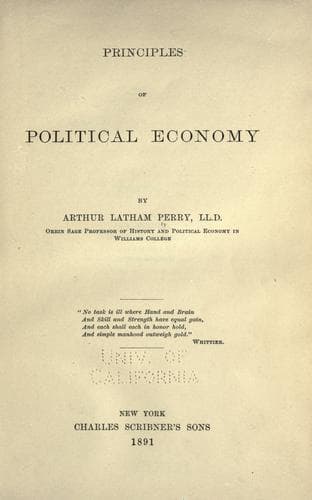
Principles of Political EconomyPerry, Arthur Latham
General
Principles of Political Economy
Perry, Arthur Latham
Economics
(c) Tariff Monopolies. The United States has never undertaken, like
France and Germany, to vend directly and exclusively an article taxed
by themselves for the sole purpose of revenue; but unfortunately they
have undertaken and still maintain (1890) monopolies a thousand times
more unjust and objectionable than any such revenue-monopoly can be;
they have laid distinct tariff-taxes upon thousands of foreign
articles, not with the design of getting revenue from them, but with
an avowed and realized design of _preventing_ revenue by means of
these taxes, since they have made the taxes so high and onerous as to
be in many cases absolutely prohibitory of the entry of the goods, and
in all cases more or less prohibitory of such entry. Revenue can only
be gotten on goods that come in, while the very intent and result of
these taxes is to shut the foreign goods out on which they are levied,
so as to give certain domestic producers (who have themselves secured
this legislation) the monopoly of the home market in these goods.
This is the very core of public wrong-doing. This is the worst form of
monopoly that ever existed in a civilized country. Queen Elizabeth's
monopolies, which so roused the ire of the Parliament of 1601, were
nothing in enormity as compared with these tariff-taxes. Civilization
long ago sloughed off such direct grants of personal privilege as were
forbidden forever by the Act of 1624, and accordingly there is no need
of mentioning these in the present classification. Tariff-taxes for
other ends than pure revenue are the worst monopolies in existence,
because (1) they compel the people to pay under ostensible taxes many
times more than the Treasury gets from them in actual revenue; (2)
they are wholly deceptive in their terms, and their operation is
clothed in disguises difficult to strip off; (3) they are always put
on at the instance and under the pressure of the man (or men) who
expects thereby to raise the price of his own wares at the expense of
his countrymen; (4) they create under legal forms however
unconstitutional privileged classes in the community; (5) their first
effect is invariably to make the rich richer and the poor poorer; (6)
their ultimate effect is to impoverish the privileged classes
themselves by taking away from them the natural spur of competition
and self-dependence, in consequence of which their own goods become
poor, and their zeal flags, and they come to lean still more heavily
on monopoly-supports; (7) they destroy the market for domestic goods
to precisely the same extent as they cut off the market for foreign
goods, and (8) their whole retinue of evils is wrapped up in the great
fact, that the _Diversity of Relative Advantage_ is thereby diminished
both as among domestic producers of commodities and as between foreign
and domestic producers.
Public-domain text, read in full here on John Shaqi.
Reviews
Reviews
No reviews yet
Be the first to share your thoughts on this work.
Elsewhere in the archive
Join the Discussion
Join the discussion
Sign in to leave a comment or review.
Sign InorCreate an account