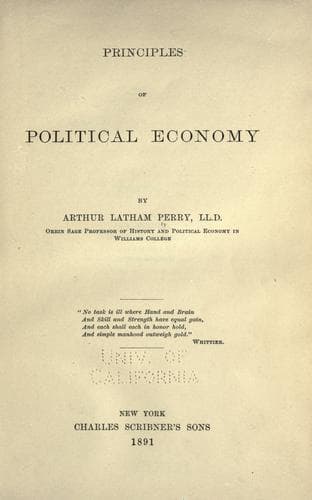
Principles of Political EconomyPerry, Arthur Latham
General
Principles of Political Economy
Perry, Arthur Latham
Economics
5. We must now study with considerable pains the ultimate facts and
the essential functions of LANDS in connection with the Production of
material commodities. This has always been the most vexed question in
our Science; but it is approaching, even if it has not already
reached, a satisfactory and final solution. The present writer
believes that his own studies and researches have thrown some original
and important light upon the perplexing problem of the Value of lands
and of their produce. His present readers are surely entitled to his
clearest possible presentation of all the facts and principles of this
radical question.
The French "physiocrats" of a hundred years ago, founders of the first
School in Political Economy, excellent men for the most part as well
as good economists in general, thought, that lands were property in a
peculiar and eminent sense, that they were the ultimate source of all
values but their own, and that consequently lands should bear the
weight of the national taxes. English economists, constituting with
their followers in other countries the second School in our Science,
while not going to the length of the physiocrats, still maintained
that the value of lands and of the produce of lands were distinct in
important respects from all other values whatever. In our own time and
country, Henry George, though belonging for the most part to the third
economic School, is a great stickler for a single tax on lands in lieu
of all other taxes. We must, then, concentrate all the lights we can
gather on these points of dispute and difficulty.
(a) _The presumption in science is always against the existence of a
few outlying cases, whenever the induction has been long and carefully
conducted by many persons, and the generalization appears on all other
grounds to be sound and comprehensive._ All induction proceeds upon
the premise, that Nature is _uniform_ in those essential resemblances
that constitute a _class_ of things in science. Nature has so often
justified confidence in her essential resemblances even under the
greatest differences in external circumstance and apparent diversity,
that the presumption becomes immensely strong in her favor, whenever a
generalization patiently gathered from many particulars seems to cover
the whole ground concerned except a few obstinate-looking items, that
have not yet been closely studied. Two to one these items also will
presently fall into their predestined place. We have already seen
abundant grounds for believing, that Values arise from human services
rendered and received: is it at all likely, considering the nature of
scientific generalization and the history of all the more advanced
sciences, that in Political Economy, lands and their produce should be
found to constitute an outlying exception to the law of all other
valuable things?
Public-domain text, read in full here on John Shaqi.
Reviews
Reviews
No reviews yet
Be the first to share your thoughts on this work.
Elsewhere in the archive
Join the Discussion
Join the discussion
Sign in to leave a comment or review.
Sign InorCreate an account