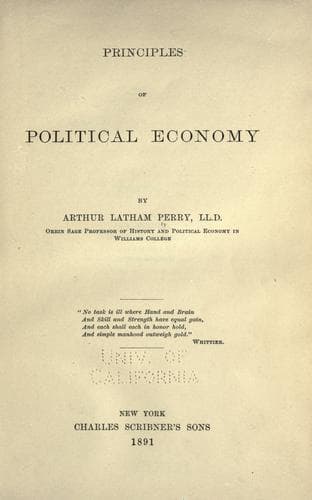
Principles of Political EconomyPerry, Arthur Latham
General
Principles of Political Economy
Perry, Arthur Latham
Economics
(e) Land-parcels becoming valuable in the way but just now indicated,
and so long as they continue valuable, that is, salable, are
technically _Commodities_, according to our triple division of all
Valuables. They belong in this grand division, that we are specially
studying in this chapter, for the same reason as a horse does or a
steam-engine does. Men did not originally make the land as a congeries
of matter, neither do men make horses, nor do they make the iron ore
out of which most parts of the steam-engine is made; but men do modify
bits of the land as God made it, they subdue it, they improve it in
manifold ways, they make it _desirable_ in the eyes of other men, and
thus or otherwise they come into possession of it, gain for themselves
a right to sell it, prepare it to be sold and sell it, on the same
principle as men raise and break and train horses and prepare them to
be sold and sell them, and just as men by many processes transform the
iron ore into a steam-engine and sell that. Ricardo, in his famous
doctrine of Rent, says a good deal about "the original and
indestructible powers of the soil"; but as a matter of fact, _there
are no such powers_, since the elements and properties that constitute
land are all the time changing under chemical and other action; and
even if there were such powers, it would still be impossible to
separate what God did for the land from what men have done in order to
fit it to be sold; and what men have ever been authorized to take pay
from other men for what God did in the creation of the world? The
simple truth is, that Value is never of God's creation but only of
men's exertion. There never was any land anywhere fit for cultivation
and sale without more or less expenditure of human labor and reserved
capital upon it; and the "powers" of the land, whatever they are,
instead of being "indestructible," are in a constant process of
wearing out, and require a constant application of labor and capital
to keep up their fertility. Valuable pieces of land, accordingly, like
all other commodities, derive their _utility_ partly from the free
contribution of Nature, and partly from the onerous contribution of
men; but, on the other hand, they derive their _value_, whether the
value be then increasing or diminishing, wholly from human desires and
corresponding efforts.
Public-domain text, read in full here on John Shaqi.
Reviews
Reviews
No reviews yet
Be the first to share your thoughts on this work.
Elsewhere in the archive
Join the Discussion
Join the discussion
Sign in to leave a comment or review.
Sign InorCreate an account