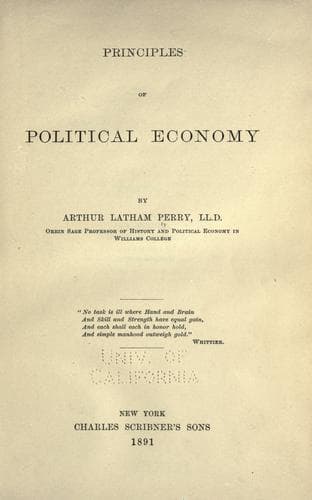
Principles of Political EconomyPerry, Arthur Latham
General
Principles of Political Economy
Perry, Arthur Latham
Economics
(f) It is but a step from this impregnable position to another,
namely, that Henry George is wholly wrong in his view, that there is
Value in lands as God made them and gave them to men in common; and
consequently, wholly wrong in his doctrine, that a single tax on land
values would be just and equal to land owners, and might well be made
to take the place of all other taxes on all other persons. He says:
"_If we are all here by the equal permission of the Creator, we are
all here with an equal title to the enjoyments of his bounty._" What
bounty? If he means the original utility which God put into all lands
in common, and which certain men have done nothing to better, there is
nobody to dispute his proposition. But he does not mean that, because
there is nothing of any significance that could come out of that. What
he means is, that it is God and not man who makes lands valuable. He
makes no distinction between Utility and Value in lands. He lumps the
two together in one, and calls the aggregate the Creator's "bounty."
He goes on to say: "_There is on earth no power which can rightfully
make a grant of exclusive ownership in land._" Well! Is there any
power on earth which can rightfully deny to any man or family the
proprietorship of his own exclusive _efforts_, nobody's else rights
being infringed thereby? Or can deny to him or them the _results_ of
such efforts, however embodied? When valueless lands are made valuable
by human efforts expended to that end, does not the "value" belong to
those who made it? When valuable lands have been made more valuable
than they were by the efforts and foresight of their owners, the
rights of others untouched, does not the "increment" belong to those
who have created it? The truth is, if Henry George's powers of radical
analysis had been at all equal to his remarkable power of rhetorical
presentation, the world would never have been treated to his popular
and imposing land-fallacies. Prudhon's "Property is theft," and
George's "Single tax on land," rest on the same basis of socialism.
Public-domain text, read in full here on John Shaqi.
Reviews
Reviews
No reviews yet
Be the first to share your thoughts on this work.
Elsewhere in the archive
Join the Discussion
Join the discussion
Sign in to leave a comment or review.
Sign InorCreate an account