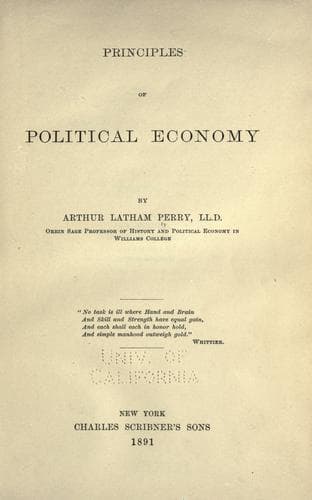
Principles of Political EconomyPerry, Arthur Latham
General
Principles of Political Economy
Perry, Arthur Latham
Economics
Agriculture always has been and always will be the vocation of the
masses of mankind. Under a fair freedom, and a decent law, and a
reasonable industry, Agriculture is always profitable; because it is
natural, that is, designed by God for the welfare of mankind; because
it lies at the basis of all other industries,--most of the food of
mankind, most of the raw material of all manufactures, most of the
subject-matter of all national and international commerce,--come out
of the farms of the world; because it has been ordered so in the
nature of things, that, under a tolerable freedom, a given amount of
agricultural products tends constantly to buy, that is, to pay for,
more and more of almost all kinds of manufactured products, for a
reason to be explained shortly, thus tending strongly to uplift the
farming masses in a scale of comforts; and because there is no other
main line of human activities so constantly and so prodigiously and so
gratuitously assisted by Natural Agents as is Agriculture. As Milton
has profoundly expressed it in the "Hymn to the Nativity," the Sun is
indeed to Mother Earth "_her lusty paramour_." But at this very time
of writing a wail is coming up in ever deepening tones from Italy and
France and Germany and Russia and especially the United States, that
a colossal blunder in legislation common to all these countries now,
say rather a colossal crime of the powerful few against the humble
many, in the shape of tariff-monopolies, neutralizes in large part
these natural advantages of agriculture, makes farming unprofitable
and farmers unable to pay their taxes, diverts young men in increasing
numbers from the farms to the towns, plasters the lands over with
mortgages, shuts out from their natural markets the products of the
land, thus depressing their price, and shuts off from farmers by
outrageous taxes their natural supplies, thus augmenting their price.
Farmers in all these countries are revolving between the upper and the
nether millstones. Count Giusso, ex-Mayor of Naples, and now a deputy
from that city, has just made a speech in the Italian Parliament,
which sets forth in strong terms the great depression in Agriculture,
and the critical condition of the public finances, brought about by
the new policy of protectionism there. He says: "_The Utopian idea of
creating an industrial Italy on the ruins of an agricultural Italy,
has been a colossal error big with disastrous results. We have
preferred the shop to the land; we have preferred the coal we do not
possess to our Italian sun; we have preferred the motive force of
steam to the most powerful motive force in the universe, the sun; and
we are naturally suffering the sad consequences._" Exports increased
in Italy in 1888 by $24,000,000, and imports by $42,000,000; and the
Count quotes the cry coming up from one end of the Peninsula to the
other: "_Give us the means of selling our products, and we will pay
Public-domain text, read in full here on John Shaqi.
Reviews
Reviews
No reviews yet
Be the first to share your thoughts on this work.
Elsewhere in the archive
Join the Discussion
Join the discussion
Sign in to leave a comment or review.
Sign InorCreate an account